



Auto Parts Inventory Management When the Pad Fits One Year Range
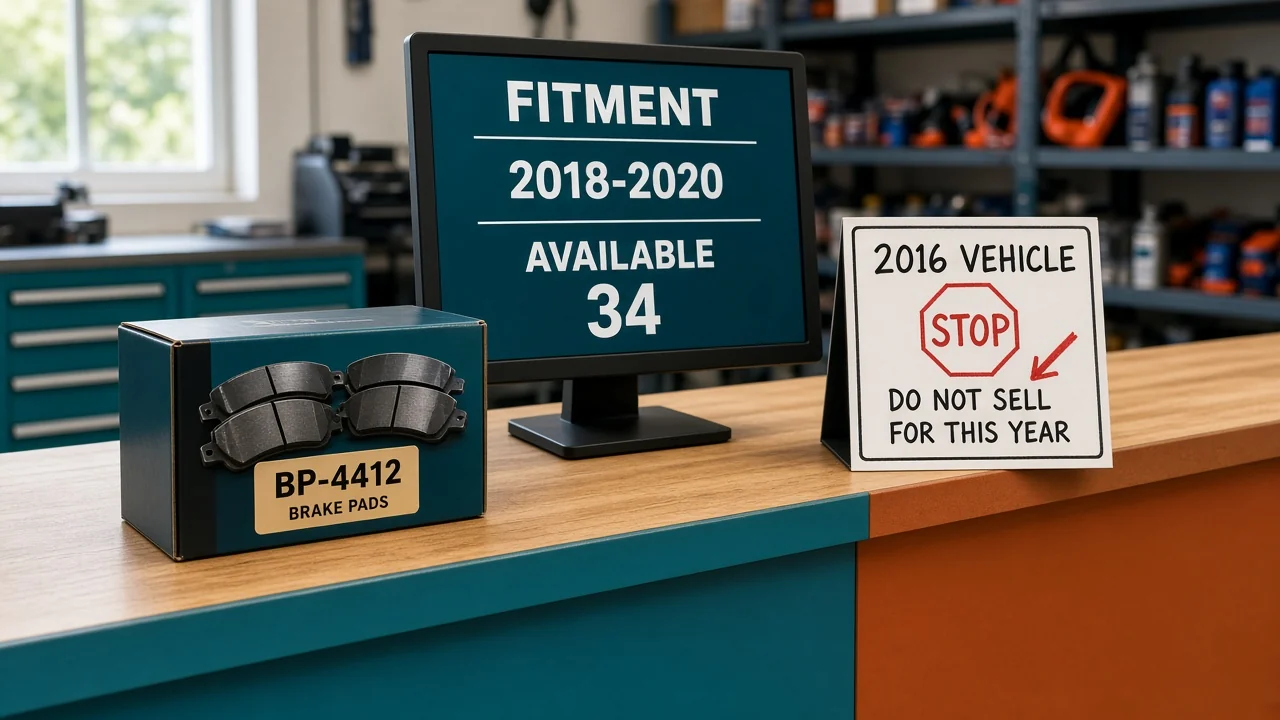
The counter sold BP-4412 for a 2016 Passat. In this example the fitment row starts at 2018. Auto parts inventory management has to stop that sale before the box leaves the shelf.
A year that is "close" is still the wrong vehicle.
What does auto parts inventory management have to know?
It has to know which vehicles the part fits, how many you can still sell, and whether a core comes back. On-hand quantity alone will sell a pad into the wrong year. The fitment row is the record that says no.
The Auto Care Association defines the Aftermarket Catalog Exchange Standard (ACES) as the aftermarket data standard for product fitment, and the Product Information Exchange Standard (PIES) as the standard for product information. Both are machine-readable XML for trading partners. Your shelf still needs its own quantity, counted in the bin. The file does not replace the bin.
GS1 US says a GTIN identifies a trade item. BP-4412 is one trade item. A different compound, a left-side pad, or a kit with clips is a different trade item and should not share that id.
What is on the fitment row?
This row is a labeled example, not a published ACES file and not a claim about a real Passat.
Field
This example
SKU
BP-4412
Part
Front brake pad
Year
2018 through 2020
Make and model
The example vehicle family you typed
Qualifier
Front axle only
Not in the row
2016, rear axle, a kit with wear sensors
If the customer says 2016, you do not stretch 2018. You look for a different SKU whose row includes 2016, or you tell them you do not have a fit. Adding 2016 because the box looks the same is how the return happens on Friday.
A qualifier is part of the fit. "Front" means the rear pad is another SKU even when the photo is similar. Put the axle in the title the picker sees, not only in a PDF nobody opens.
How do you count the pad?
Start with on hand, which is 40 in this example. Open orders have committed 6. Available to sell is 34. Do not publish 40 on the website or the next six orders oversell the bin.
The example shelf price is $28. The example core is $15, recorded separately. The customer pays $43 at the counter if they do not hand you a core today.
When the old pad comes back in acceptable shape, the $15 is a credit, not a discount on the $28. Mixing those numbers makes the next price file look like the part costs $43.
A core that fails inspection does not get the credit. Write the reason on the return. "Customer unhappy" is not a core condition.
Inventory management is where available should be calculated from on hand minus what is already promised. The fitment check sits in front of that math. A perfect available count still ships the wrong year if nobody read the row.
Why are left and right two SKUs?
Some pads are boxed as an axle set. Some are boxed as one side. If your box is one side, left and right are two records. Selling "BP-4412" for both sides because the number on the old pad was similar will put two left pads on one car.
Supersession is a second trap. When the supplier replaces BP-4412 with BP-4412A, the old number can stay as a search alias. The stock, the price, and the fitment move to the new SKU. Leaving 12 units on the dead number means the website says out of stock while those 12 sit in the original bin.
Purchasing should reorder the live SKU. A min on the discontinued number keeps buying a part the catalog no longer fits to the years you sell.
What do you import before you sell?
PIES carries the product story: descriptions, packaging, attributes. ACES carries the fitment. You need both before a public page goes up. Importing a pretty title with no year range gives you a page that cannot say no.
Do not type a vehicle into the web label that is absent from the fitment file. If a buyer asks for a note you cannot support, the answer is a new file from the brand, not a sentence a salesperson adds at 6pm.
Brand cross-references belong in a table with a source. "Same as the other brand" on a sticky note is not a fitment row. When two brands share a vehicle, each SKU still has its own on-hand count. Substituting at the counter without decrementing the box you actually pulled is how the night count is short.
Product information is the place for the attributes that must match the package. Height, axle, and included hardware should come from the file, not from the last listing that ranked.
How do you check one part before it ships?
Open BP-4412 and read the year range. In this example it is 2018 through 2020.
If the vehicle is 2016, stop. Do not pick the box.
Confirm the qualifier. Front does not fill a rear request.
Read available, not on hand. Here that is 34, because 6 are already committed.
Ring the part at the example $28 and the core at $15 as separate lines if no core is in hand.
Scan the bin so the 40 becomes 39 only for the box that left, and only on the SKU you picked.
Keep one rejected 2016 attempt in the training notes. New clerks repeat the sale you do not show them.
Warehouse locations keep the 40 in a bin you can count. A fitment file cannot fix a pad stored under the wrong label.
What does the picker see on the label?
The bin label has to carry the year range and the axle, not only the SKU. BP-4412 with "front, 2018-2020" on the lip of the shelf stops a 2016 grab faster than a catalog screen in the office.
Put the bin code on that same label. In this example the 40 pads live in bin F-12. If 10 of them were shoved onto F-14 during a rush, the system still says 40 and the picker finds 30.
Write a move when the carton moves. A second location is fine. A secret location is how the night count loses ten pads that are one aisle over. Stamp the year range on the carton too, so a box pulled from the back still shows 2018 through 2020 without a terminal.
Do not pick from the photo on the website. Two compounds can share a shape. The barcode on the box has to match BP-4412 before it goes in the tray. A scan that fails is a stop, not a manual override "because it looks right."
When the core comes back over the counter, tag it with the original ticket number before it hits the core bin. A loose pad in a bucket cannot be credited to the $15 later, because you will not know which sale it belongs to.
Count F-12 on a quiet morning and compare it with the 40. If you are short, look at F-14 and at open orders before you change the system number. Adjusting on hand to match a partial glance just moves the error into the next order.
Questions about fitment and the bin
Can you sell the pad if the year is one off?
A one-year miss is still a miss. In this example 2016 is outside 2018 through 2020. Offer a SKU whose row includes 2016, or do not sell BP-4412 for that car.
Is available the same as on hand?
Available is what you can still promise. On hand 40 minus 6 committed is 34. Publishing the on-hand figure sells pads that are already promised to someone else.
Where does the core charge go?
Core money stays off the part price. The example is $15 beside $28. A returned core in good shape credits the $15. It does not rewrite the part price.
Can left and right share a SKU if the photo matches?
Only when the box is actually an axle set that includes both sides. A one-side box needs its own SKU so you do not hand over two left pads.
Is the 2018 row a real catalog statement?
No. The years, the $28, and the $15 core are examples so you can see the check. Load your own ACES row before you block a real vehicle.
OneChannelAdmin Team writes about parts counters, fitment files, and the bin counts that have to match them.
Scale Your Multi-Channel Commerce Operations with 1CA
Discover how OneChannelAdmin unifies inventory management, WMS warehouse operations, order fulfillment, and automated marketplace repricing.