
Ecommerce Accounting Software
Platform
Ecommerce accounting for multichannel sellers — ledger, invoices, marketplace fees, inventory valuation, refunds, payouts and P&L in one connected finance workspace.
Ecommerce Accounting is best for
- Multichannel sellers
- Marketplace businesses
- Finance teams reconciling fees and inventory
- Operators needing P&L and cash-flow visibility
Complete Accounting Platform
Automated accounting software connects financial operations, inventory activity, and order management to deliver real-time financial visibility across the business.
Unified finance view
Unified finance view connects sales, fees, refunds, and adjustments.
Order linking
Order linking ties every transaction back to the original order.
Inventory sync
Inventory sync reflects stock movements and cost impacts accurately.
Role controls
Role controls restrict approvals and sensitive finance actions.
Audit history
Audit history records changes for accountability and compliance.
API connectivity
API connectivity supports integration with banks and gateways.
Live dashboards
Live dashboards shows revenue, expenses, and cash flow trends.


Core Capabilities
Financial transaction management supports automated capture and categorization across ecommerce activity.
General ledger
General ledger accounting maintains structured accounts and audit-ready journal entries.
Invoicing and billing
Invoicing and billing automation generates invoices, reminders, and recurring charges.
Payment reconciliation
Payment reconciliation matches payouts, fees, and deposits to accounting records.
Financial reporting
Financial reporting analytics delivers P&L, cash flow, and profitability insights.
Tax management
Tax management and compliance tracks liabilities and supports filing-ready reports.
Financial Transaction Management
Ecommerce accounting software captures transactions from orders, refunds, fees, and adjustments to reduce manual bookkeeping and errors.
Transaction capture
Transaction capture records sales, refunds, discounts, and adjustments.
Fee tracking
Fee tracking records marketplace fees, shipping charges, and processing costs.
Auto categorization
Auto categorization applies rules for income and expense classification.
Multi-channel imports
Multi-channel imports supports ecommerce, POS, and wholesale transactions.
Exception flags
Exception flags highlights missing mappings and unusual entries.
Audit trails
Audit trails records edits and rule changes with timestamps.
Export tools
Export tools supports downstream reporting and finance workflows.


General Ledger Management
General ledger accounting organizes financial activity with chart of accounts, journal entries, balances, and reconciliation-ready records.
Chart of accounts
Chart of accounts supports assets, liabilities, revenue, and expenses.
Journal entries
Journal entries supports automated and manual adjustment entries.
Account balances
Account balances updates balances with every posted transaction.
Period close controls
Period close locks reporting periods and enforces close controls.
Approval controls
Approval controls restrict postings and sensitive account changes.
Audit logs
Audit logs stores posting history for compliance reviews.
Balance views
Balance views supports drilldowns by account and date range.
Invoice and Billing Automation
Invoicing and billing automation generates invoices, recurring charges, reminders, and statements for customers, B2B accounts, and services.
Invoice generation
Invoice generation creates invoices from orders and service workflows.
Recurring billing
Recurring billing supports subscriptions and contract billing cycles.
Payment reminders
Payment reminders sends overdue reminders with configurable timing.
Partial payments
Partial payments tracks balances and outstanding invoice amounts.
Credit note management
Credit notes handle returns, adjustments, and account credits.
Customer statements
Customer statements supports monthly statements for account customers.
Invoice history
Invoice history stores sent, paid, overdue, and void states.


Payment Reconciliation
Payment reconciliation matches bank deposits, gateway payouts, fees, and chargebacks to orders for accurate financial records.
Bank imports
Bank imports syncs deposits and withdrawals from connected accounts.
Payout matching
Payout matching matches gateway payouts to order batches.
Fee reconciliation
Fee reconciliation reconciles processing fees and marketplace charges.
Chargeback tracking
Chargeback tracking records disputes and resolution outcomes.
Mismatch detection
Mismatch detection flags missing deposits and timing gaps.
Approval workflows
Approval workflows supports review before posting reconciliations.
Reconciliation reports
Reconciliation reports exports matched and unmatched summaries.
Financial Reporting and Analytics
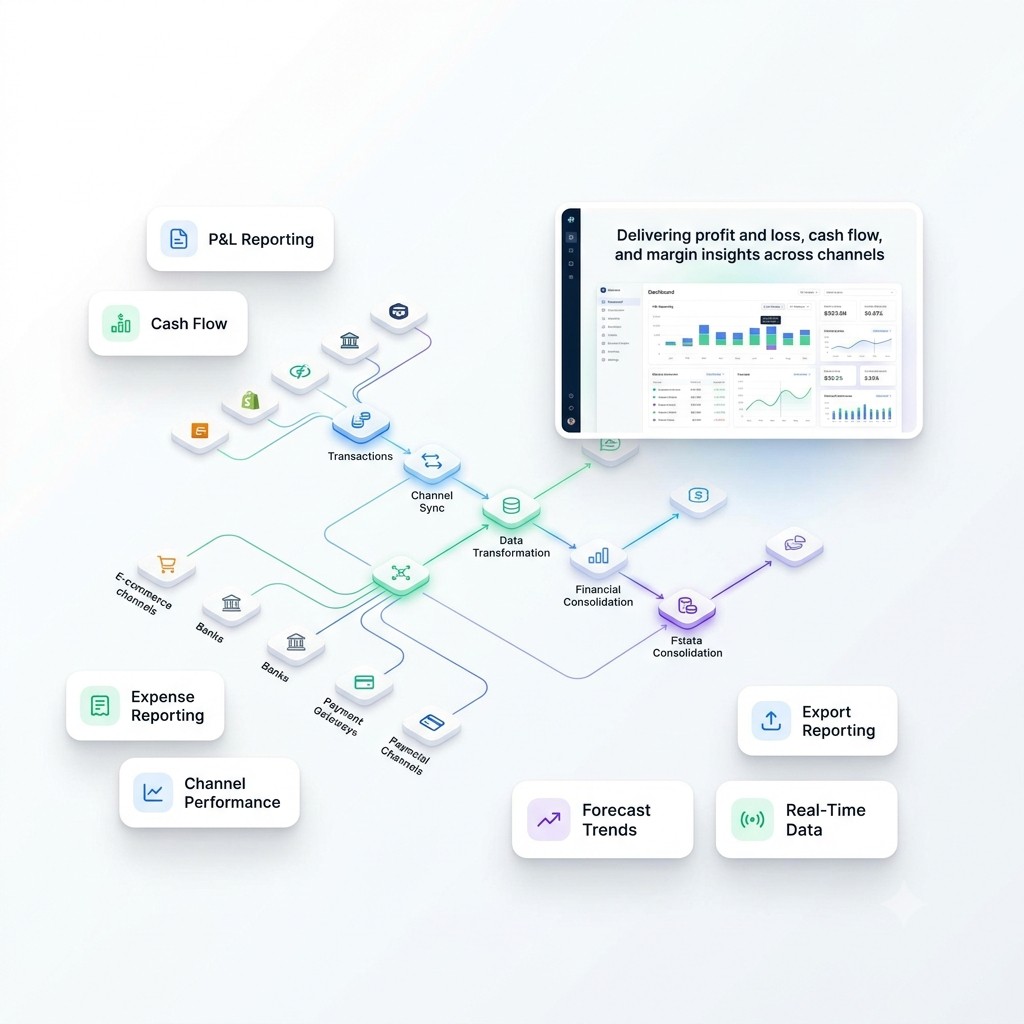
Financial reporting analytics delivers profit and loss, cash flow, margin insights, and performance dashboards across channels and locations.
P&L reporting
P&L reporting shows revenue, expenses, and profitability trends.
Cash flow views
Cash flow views tracks inflows and outflows over time.
Margin analysis
Margin analysis measures gross margin by SKU and channel.
Expense reporting
Expense reporting groups spend by category and vendor.
Channel performance
Channel performance compares marketplaces, ecommerce, and wholesale.
Forecast trends
Forecast trends highlights seasonality and revenue patterns.
Export reporting
Export reporting supports CSV exports and scheduled sharing.

Tax Management
Tax management and compliance tracks sales tax liabilities, reporting periods, and filing-ready summaries across jurisdictions and channels.
Tax calculation
Tax calculation records tax collected per transaction and location.
Liability tracking
Liability tracking tracks tax owed by state and jurisdiction.
Filing reports
Filing reports prepares summaries for filing and remittance.
Exemption handling
Exemption handling supports exempt customers and resale certificates.
Marketplace handling
Marketplace handling separates marketplace collected versus direct tax.
Audit readiness
Audit readiness stores evidence for tax review and disputes.
Benefits of Ecommerce Accounting
Reduce manual bookkeeping, improve accuracy and control, strengthen cash flow and profitability, and reduce tax risk with ecommerce accounting software.
Reduce manual
Bookkeeping with ecommerce accounting software that captures transactions, fees, and refunds automatically across channels.
Improve accuracy
With payment reconciliation that matches payouts, fees, and chargebacks back to orders and batches.
Improve control
With general ledger accounting using approvals, audit logs, and close controls for finance teams.
Improve cash flow
With invoicing automation, recurring billing, reminders, and statement workflows for account customers.
Improve profitability
With financial reporting analytics showing margin by SKU, channel performance, and expense trends.
Reduce tax risk
With tax management and compliance tracking liabilities, exemptions, and filing-ready reports by jurisdiction.
Traditional Ecommerce Accounting vs 1CA Ecommerce Accounting
A capability comparison, not a competitor list. This is how 1CA handles Ecommerce Accounting versus disconnected tools.
Traditional Ecommerce Accounting
- Marketplace fees reconciled in monthly exports
- Inventory value that does not match channel sales
- Separate tools for invoices, payouts, and P&L
- Cash-flow surprises after payout cycles close
1CA Ecommerce Accounting
- Ledger, invoices, and channel fees in one accounting workspace
- Inventory valuation connected to ecommerce activity
- Automated posting for orders, refunds, and marketplace fees
- P&L, cash-flow, and reconciliation dashboards for operators
Frequently Asked Questions
Answers to common operational inquiries.