
Service
Management
Work sheets, physical asset trackers, dispatching & metrics.
Service Management is best for
- Field service teams
- Work-order and dispatch operations
- Equipment service organizations
- Teams tracking technicians, parts, and completion
Service Management Platform Overview
Service operations management software centralizes service requests, work orders, schedules, and customer history to improve response speed and consistency.
Unified workspace
Connects tickets, work orders, and customer records.
Role permissions
Controls access for agents, managers, and technicians.
Queue visibility
Shows workload, priorities, and backlog by team.
Status tracking
Shows new, in progress, waiting, and resolved.
Audit history
Records edits, approvals, and workflow changes.
Multi-location support
Manages sites and service regions consistently.
API connectivity
Integrates commerce, inventory, and finance systems.


Customer Service Request Management
Customer service management software captures requests from portals, email, phone, and web forms with structured categorization and tracking.
Ticket intake
Ticket intake supports portal forms, email, and manual creation.
Issue categories
Issue categories standardizes reason codes for faster routing.
Priority rules
Priority rules assigns priority based on customer tier and SLA.
Customer notifications
Customer notifications sends updates when status changes.
Attachment support
Attachment support stores photos, documents, and troubleshooting files.
Conversation history
Conversation history keeps all messages tied to the ticket.
Knowledge prompts
Knowledge prompts suggests troubleshooting steps for faster resolution.
Service Automation Platform
Service automation platform automates routing, assignments, approvals, and escalations to reduce manual work and improve SLA performance.
Auto routing
Auto routing assigns tickets to the right team instantly.
Rules engine
Rules engine applies workflows by product, channel, and customer.
SLA timers
SLA timers tracks response and resolution time commitments.
Escalation paths
Escalation paths escalates stalled tickets based on SLA rules.
Approval flows
Approval flows routes replacements and credits for review.
Task automation
Task automation triggers checklists and follow-up actions.
Exception queues
Exception queues highlights high-risk cases needing attention.


Work Order Management
Service management software converts tickets into work orders with tasks, parts, notes, and completion confirmation for service execution.
Work order creation
Work order creation converts tickets into structured work orders.
Task assignment
Task assignment assigns technicians by skills and workload.
Parts tracking
Parts tracking links spare parts usage to each job.
Technician notes
Technician notes stores diagnostics, photos, and attachments.
Status updates
Status updates tracks dispatched, in service, and completed states.
Completion proof
Completion proof records sign-off and customer confirmation.
Work history
Work history stores full service records for every asset.
Field Service Scheduling and Dispatch
Field service management software schedules appointments and dispatches technicians with availability, route planning, and customer time windows.
Appointment booking
schedules visits with customer time windows.
Technician availability
tracks schedules, skills, and workload.
Dispatch board
assigns jobs by region and priority.
Route planning
reduces travel time and missed appointments.
Mobile updates
supports technician status updates in the field.
Customer alerts
sends ETAs and arrival notifications automatically.
Reschedule workflows
supports changes without losing history.

Service Analytics and Reporting
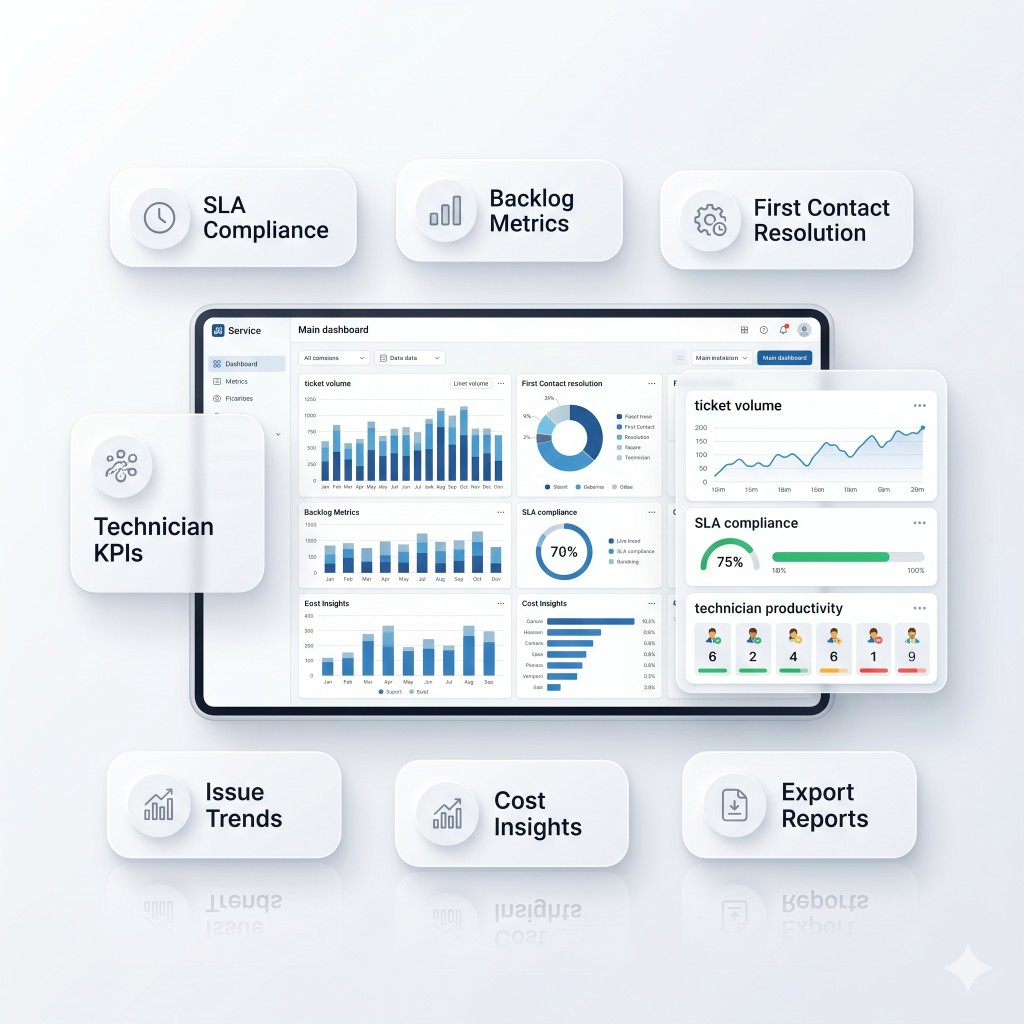
Service operations management software dashboards track ticket volume, SLA compliance, resolution quality, and technician productivity in real time.
SLA compliance
SLA compliance tracks response time and resolution performance.
Backlog metrics
Backlog metrics shows queue health and aging tickets.
First contact
First contact resolution measures effectiveness of support workflows.
Technician KPIs
Technician KPIs tracks completion rate and time per job.
Issue trends
Issue trends identifies recurring problems by product and category.
Cost insights
Cost insights tracks labor and parts costs by service type.
Export reports
Export reports shares KPIs with leadership and operations teams.
Field Service Reporting
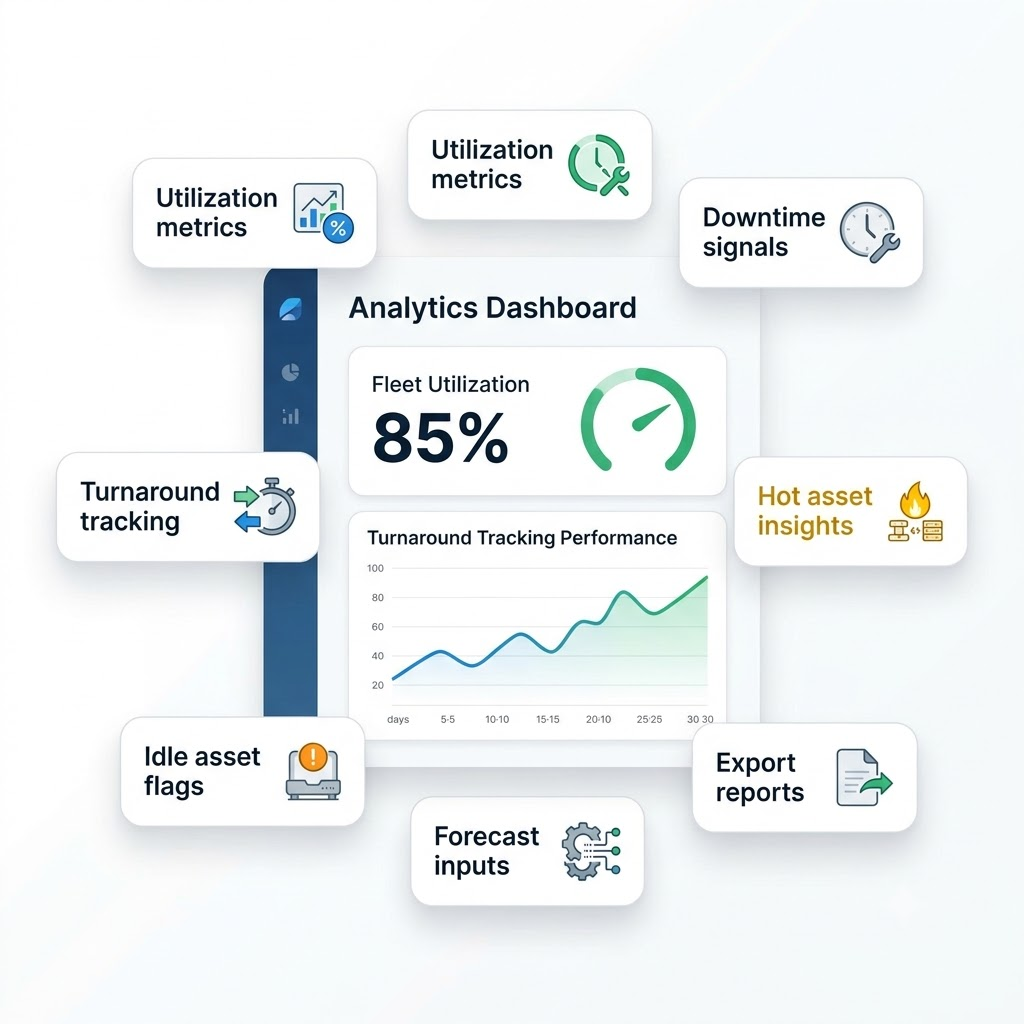
Field service management software reporting tracks SLA compliance, productivity, travel efficiency, and service quality across technicians and regions.
SLA dashboards
SLA dashboards tracks response and resolution performance.
Productivity KPIs
Productivity KPIs measures jobs completed and time per job.
Travel metrics
Travel metrics tracks miles driven and travel time trends.
First fix rate
First fix rate measures repeat visits and quality outcomes.
Backlog insights
Backlog insights shows open jobs and aging work orders.
Issue trends
Issue trends identifies recurring problems by category and product.
Export reports
Export reports shares results with leadership and operations teams.

Security and Compliance
Service management software security controls protect audit logs, role permissions, fraud detection, and compliance reporting across service operations.
Role permissions
Role permissions controls access for agents, managers, and technicians.
Audit logs
Audit logs records edits, approvals, and workflow changes.
Fraud controls
Fraud controls flags anomalous activity and high-risk actions.
Data security
Data security protects customer records and service documentation.
Compliance logs
Compliance logs stores evidence for audits and policy reviews.
Driver verification
Driver verification validates field technician identity and access.
Approval rules
Approval rules enforces sign-off for refunds, credits, and exceptions.
Integrations and Connectivity
Service management software integrates with ecommerce, inventory, CRM, and accounting systems to connect orders, warranties, and service history.
Order linking
Order linking ties tickets to original orders and customer data.
Warranty checks
Warranty checks validates eligibility using purchase history fields.
Inventory sync
Inventory sync reserves parts and tracks replacement stock.
CRM sync
CRM sync updates customer profiles and communication history.
Accounting sync
Accounting sync exports credits, invoices, and service billing data.
API webhooks
API webhooks triggers events for automation and integrations.
Audit logs
Audit logs records integration actions for accountability.

Six Core Benefits of Service Management
Improve response speed, SLA performance, technician productivity, and operational visibility with service management software built for modern service teams.
Improve response speed
Service management software centralizes tickets, work orders, and customer history in one platform.
Reduce manual workload
Service automation routes tickets, enforces SLAs, and escalates stalled cases automatically.
Improve technician productivity
Work order management tracks tasks, parts, notes, and completion proof.
Increase on-time appointments
Field service management software uses scheduling, dispatch boards, and route planning.
Improve decision making
Service analytics dashboards track SLA compliance, backlog health, and recurring issue trends.
Reduce disconnected workflows
Integrations link ecommerce orders, warranties, inventory, CRM, and accounting data.
Traditional Service Management vs 1CA Service Management
A capability comparison, not a competitor list. This is how 1CA handles Service Management versus disconnected tools.
Traditional Service Management
- Tickets, work orders, and dispatch in separate inboxes
- Technician location and parts usage recorded after the visit
- Service history hard to find when a customer calls back
- Little visibility into completion time and repeat visits
1CA Service Management
- Tickets convert into work orders with tasks, parts, and notes
- Dispatch, technician tracking, and completion in one workflow
- Service history and documentation stored on the asset and customer
- Analytics for dispatch, completion, and field-service performance
Frequently Asked Questions
Answers to common operational inquiries.