
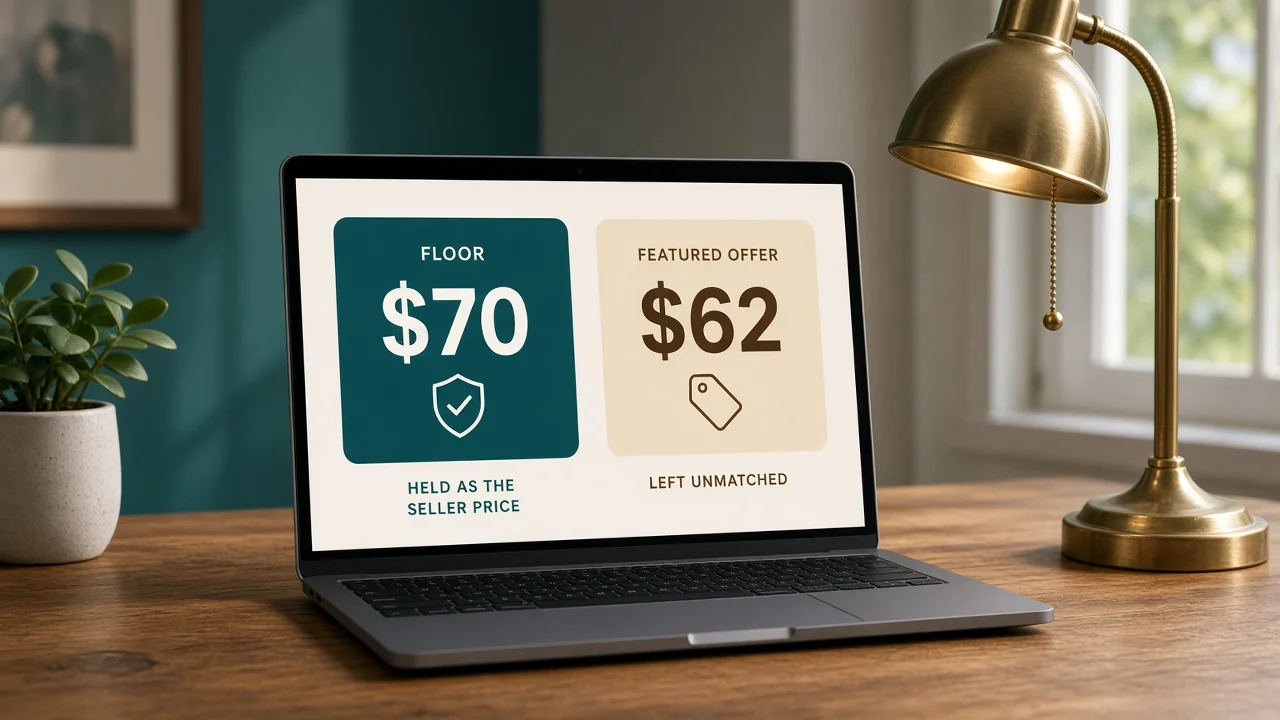
The Featured Offer on the lamp fell to $62. The rule matched it before anyone looked. Your floor for that SKU was $70. An Amazon repricing strategy is the minimum you set before a match is allowed to happen.
A lower price is not a strategy. It is what the rule does when you forget the floor.
What is an Amazon repricing strategy?
It is one rule, a required minimum, and an optional maximum. Amazon's Automate Pricing guide says the Professional plan tool adjusts prices after a Featured Offer change. You set the minimum before that adjustment runs.
Amazon's developer docs say you can attach each SKU to only one pricing rule at a time, and that the safe way to do it is to set the minimum and maximum prices on that SKU. One lamp, one rule, one floor.
Where do $60 and $70 come from?
LAMP-14 in this example. These dollars are not Amazon's fee card.
| Piece | Example amount | What it is |
|---|---|---|
| Landed cost | $40 | What the lamp cost you, inbound included |
| Channel fees | $12 | A stand-in number, not a published rate |
| Margin you refuse to give up | $8 | Your choice |
| Cost floor | $60 | 40 + 12 + 8 |
| Advertised floor | $70 | The MAP you are willing to show |
| Optional ceiling | $84 | So a scare does not jump the price |
The minimum you hand Amazon is the higher of the cost floor and the advertised floor. Here that is $70. A rule that may match $62 will clear $60 and still break the $70 promise.
If you have no MAP, the minimum is still $60. Matching $55 would mean you paid the buyer to take the lamp. I would rather lose the Featured Offer for a day.
What should the rule do at $62?
| Live Featured Offer | Your price before | What the rule may do |
|---|---|---|
| $74 | $80 | Move to $74. It is above $70 and under $84. |
| $70 | $80 | Move to $70. That is the floor, not a dollar under it. |
| $62 | $80 | Stay at $70. Do not match. |
| $90 | $80 | Stay, unless a separate rule you wrote says to rise. The ceiling is $84, so $90 is not a target. |
"One cent under the Featured Offer" feels competitive until the Featured Offer is a stranger liquidating stock. Your minimum is the whole strategy. The match is a convenience inside it.
Pause the rule if you are not sure. Amazon's setup page says you choose the rules and set a minimum before you start repricing. Starting without the $70 is how the $62 match happens at dinner.
Which price is Amazon allowed to chase?
Chase a price only when it sits between $70 and $84 for this lamp. Featured Offer, a rival offer, or a sales rule Amazon offers are all still subject to that band. The developer docs are explicit that the SKU gets one rule. Do not stack a "match lowest" rule and a "stay at MAP" rule and hope they negotiate.
On-hand does not belong in the price field. Forty units in the building is inventory management. If you want a higher price when fewer than 5 remain, write that as a second condition inside the same rule, or change the minimum by hand when you mean it. Do not let a stock note overwrite $70.
Repricing in OneChannelAdmin is where that floor can sit before a channel match. The Amazon offer itself is the Amazon integration. A MAP you must not advertise under is MAP monitoring.
When is matching still fine?
When the Featured Offer is $74 and your price is $80. You give up $6 of price and keep $4 over the $70 floor. That is a choice you can explain on one line: "We moved to the Featured Offer because it was inside the band."
I would not match a price you cannot say out loud to the person who owns the brand. If the sentence is "we had to, the tool did it," the minimum was wrong or it was missing.
What do you do after a bad match?
Pause every SKU on that rule before you edit prices by hand. A rule that is still running will put $62 back an hour after you type $70. The pause is the fix. The typed price is a wish.
Then split the catalog. SKUs with a $70 advertised floor do not share a minimum with SKUs whose only floor is the $60 cost line. One file of minimums, with the higher number filled in, is enough. A blank minimum is how the next upload matches whatever the Featured Offer happens to be.
Read the price the shopper saw, not the name of the rule. "Competitive" can still print $62 if the minimum was $50. Write the live price next to the minimum you thought you sent. If they disagree, the upload did not take, or a second tool is also writing the offer.
Twenty bad SKUs get the same pause. Do not repair your favorite lamp and leave the other nineteen running. The strategy is the floor on all of them, or it is not a strategy.
Keep a one-line note when you change a minimum: SKU, old minimum, new minimum, date, and your name. $70 becoming $60 in a hurry is how next week's match looks like a mystery. The note is the mystery solved.
If a maximum is blank, set one before a stock rule or a scared afternoon pushes the lamp to a number you would not print on a sign. $84 in the example is that sign. A blank ceiling is not "no opinion." It is permission for a spike.
Do this on LAMP-14 before you trust a catalog file. One SKU with a written floor, a written ceiling, and a paused rule you can explain is the whole test. The file is just that test repeated.
Also write who may lower a minimum. One login is enough. A shared password will not put a name on the note, and you will be matching $62 again with nobody to ask. That login should not be the same person who only watches the Featured Offer.
Reject an upload that leaves the minimum blank. A blank is not $70. It is the strategy missing.
After any file, check the lamp and two other SKUs. One correct row can hide an empty floor on the rest of the catalog. Leave the rule paused until those three minimums are the numbers you intended, not blanks the upload accepted.
How do you test the strategy on one SKU?
- Write the cost floor and the advertised floor for LAMP-14. In this example, $60 and $70. The minimum you send is $70.
- Set an optional maximum. Here, $84.
- Attach one rule. Confirm a second rule is not also on that SKU.
- Start repricing with the live Featured Offer above $70, and read the price Amazon shows.
- When you can, use a moment where the Featured Offer is under $70, or replay yesterday's $62. Your price should stay $70.
- Pause the rule if step 5 prints $62. Fix the minimum before you resume.
Stop on step 5 if the live price is under $70. The tool worked. The floor did not.

Questions about repricing on Amazon
Does Amazon require a minimum price?
Amazon's Automate Pricing guide says minimum price limits are pre-determined and maximum limits are optional. Put the minimum in before you start. The maximum is how you stop a spike, not how you stop a collapse.
Can one SKU have two rules?
Each SKU can sit on only one pricing rule at a time, which is what Amazon's developer docs say. A MAP floor and a match have to live inside that rule's minimum, not as two automations fighting.
Should you match the Featured Offer?
Only inside the band. At $74, matching can be right. At $62, with a $70 floor, matching is the mistake the minimum exists to block.
What if you have no MAP?
The cost floor is still the minimum. In the example that is $60. A match at $55 loses money even if you win the button.
Is the $12 fee Amazon's rate?
No. It is a stand-in so the arithmetic is visible. Swap in your own fee estimate before you trust the $60. Do not copy these dollars onto a live SKU.
OneChannelAdmin Team writes about price floors, the Featured Offer, and the match a rule should refuse.
Looking for the product? See Pricing & AI Repricing Engine.
Run inventory, orders, and marketplaces in one place
See how OneChannelAdmin connects catalog, warehouse, and multichannel selling without spreadsheet chaos.