
You listed 12 hammers on Amazon on Monday. Walmart sold 4 of them on Thursday, and Amazon still showed 12, so two more orders came in for stock you no longer had. That's what goes wrong when you try to figure out how to sell on multiple marketplaces by opening another tab.
How to sell on multiple marketplaces
Keep one master record for the product and one quantity you can still ship. Publish a listing to each marketplace from that record, using that site's category and its fee. When a unit sells, every other listing drops before you take another order.
A second site pays off when the buyer never visits the first one. It doesn't pay off when you cancel the order. I'd rather have those hammers on two sites I can ship than on four sites that generate apologies.
Which marketplace should you open first?
Open the marketplace that already has a category for the item in your hand. A tool with a UPC belongs on Amazon or Walmart before it belongs on a handmade marketplace.
| If this describes the product | Open this first |
|---|---|
| Branded or standard retail item with a UPC | Amazon or Walmart |
| Handmade, vintage, or one of a kind | Etsy, or eBay if the lot is mixed |
| Heavy, and you can hand it to a local buyer | A local marketplace, then ship what is left |
Etsy is the better first home when the item is handmade or vintage. eBay fits a mixed lot, used goods, or a single unit you will not restock. Local pickup fits when the freight would eat the margin.
Start with one site. Add a second only after a week of orders ships without a stock argument. I wouldn't open a third until that second site has done the same.
How much does it cost to sell on each marketplace?
Total sales price is the number the fee uses. On Amazon and on Walmart, that includes the item plus the shipping the buyer pays.
Amazon's standard selling fees list Tools and Home Improvement at 15%, with a $0.30 minimum. The Professional plan is $39.99 a month. The Individual plan is $0.99 a sale. Walmart's referral fee table lists Tools and Home Improvement at 15% too, taken when the sale completes.
Both pages fold shipping and handling into that total. Recheck the table before you freeze a price. Category rates move.
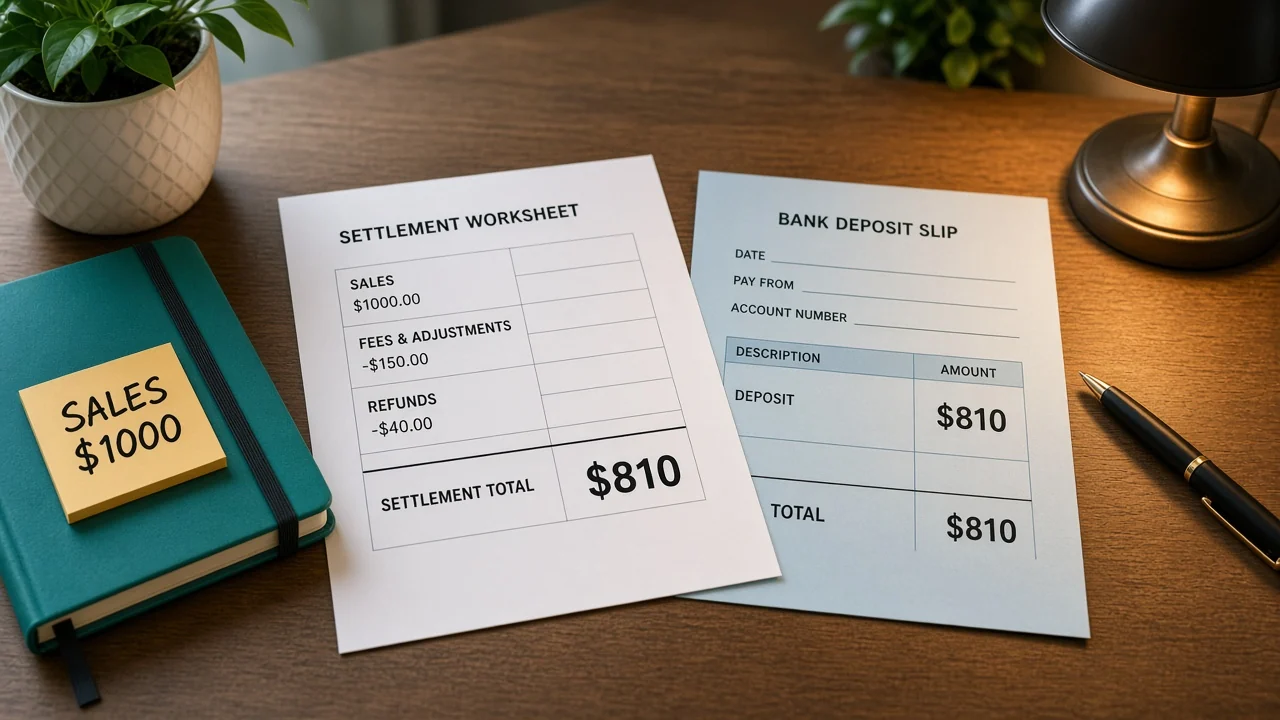
Here is an example, not a printout from your account. The tool is $40, you charge $8 shipping, and the fee base is $48. Fifteen percent of $48 is $7.20. Fifteen percent of the $40 item alone is $6.00, so ignoring the shipping understates the fee by $1.20 on each site.
Spread Amazon's $39.99 across the month's Amazon orders. At 30 orders, that share is $1.33, and 30 times $1.33 is $39.90, so nine cents is still sitting in the month. This order's Amazon bill is $7.20 plus that $1.33.
Say the tool costs you $16 and the label costs $8. Those two figures are part of the example. Money in is $48.
After the referral, the plan share, the tool, and the label, Amazon leaves $15.47. Walmart, at the same 15% and without that plan share, leaves $16.80.
On the plan fee alone, Individual stays cheaper through 40 Amazon sales in a month, because $0.99 times 40 is $39.60. The 41st sale is where the $39.99 Professional plan costs less. Professional is also the plan Amazon ties to bulk listing and ads, so a cheaper Individual month is the wrong plan if you need those tools.

How do you list one product on every channel?
Build the listing once, then publish it. Retyping the same hammer into each seller portal is how the UPC drifts.
- Give the product one SKU and reuse that SKU on every marketplace.
- Fill the category and the item specifics that site requires before you publish.
- Set the price from the worksheet above. Don't paste the Amazon price onto Walmart.
- Send the quantity you can still ship, after open orders and units on hold.
- When an order imports, reserve the unit and lower the other listings before you print a label.
OneChannelAdmin multichannel commerce publishes from that master SKU and returns each order to one queue. Inventory management is where the shippable quantity gets calculated before it goes out. Category and item specifics belong in OneProductHub, because a rejected listing never receives a stock update. Order fulfillment picks the building that packs the unit, which is a separate choice from the site that sold it.
How do you stop a double sale?
Listing the shelf count on every site is the mistake. Twelve hammers on Amazon and 12 on Walmart are still 12 hammers.
If the other site only refreshes overnight, those 12 can sell on both before morning. Push the new quantity when the order imports, or hold units back to cover what can sell during the gap.
A copied title fails in a different way. Amazon will accept a long keyword string. Walmart still wants its category and item specifics filled, and a listing that never goes live never gets the quantity cut either.
How do you fulfill orders from multiple marketplaces?
Pull every new order into one list before anyone walks to the shelf. Two seller portals means two people can pick the same hammer.
- Reserve the unit the moment the order imports.
- Pack it from the building that shows that unit on hand.
- Send the tracking number back to the marketplace that took the money.
- Cancel only before the ship-by time, and expect that marketplace to count the cancellation.
Print the label after the quantity drops, not before. A label on a unit that also sold elsewhere is how the apology starts.
When should you add another marketplace?
| What you see | What you do |
|---|---|
| Cancellations or late shipments on the site you already have | Stay there and fix shipping before you apply anywhere else |
| The fee worksheet is filled in for your top SKUs and the profit is still positive | Add one marketplace, not a batch of them |
| A sale on one site does not change the other the same day | Connect the quantity before you add another listing |
| Listings come back rejected for category or item specifics | Fix the master record, then publish again |
Two marketplaces is enough until both of them ship without you reconciling a spreadsheet at night.

How do you launch on a second marketplace?
Run this on the SKUs you actually intend to publish. The rest of the catalog can wait.
- The SKU on the new site matches the master SKU.
- The category and required item specifics are filled, not guessed.
- The fee worksheet is done for those SKUs, using each site's total sales price.
- A test order on the first site lowers the quantity on the second before you pack it.
- You know which bench packs the extra orders this week.
- If step 4 fails, stop. Don't push the rest of the catalog.
Questions about selling on more than one marketplace
Can you sell the same product on Amazon and Walmart?
Yes. The same SKU can be listed on both at once. The limit is the quantity behind it. If you only have 12 units, both listings have to draw from those 12, or you'll accept an order you cannot ship.
Can a marketplace suspend you for listing on two sites?
Listing the same item in two places is ordinary. Cancelling orders you cannot fill is what draws a penalty. Treat the double sale as a quantity problem, and fix the count before you study the policy email.
How many marketplaces should you sell on?
Sell on as many as you can update the same day a unit sells. For most sellers that is two, once the first site ships on time. Add a third only after the second one runs the same way without a weekend stock check.
What is cross-listing?
Cross-listing means the same item is for sale on more than one marketplace at the same time. Resellers use the word for sites such as eBay. The work is the same: one record, more than one listing, one quantity behind all of them.
How do you price one item on every marketplace?
Start from the total sales price, item plus shipping, and multiply by that site's rate. In the example, $40 plus $8 shipping is a $48 base. At the 15% tools rate on Amazon's fee page and on Walmart's fee page, the referral is $7.20 before Amazon's selling plan.
Written by the OneChannelAdmin Team. We spend our weeks on catalog records, marketplace quantity, and the orders that follow a sale.
Run inventory, orders, and marketplaces in one place
See how OneChannelAdmin connects catalog, warehouse, and multichannel selling without spreadsheet chaos.