
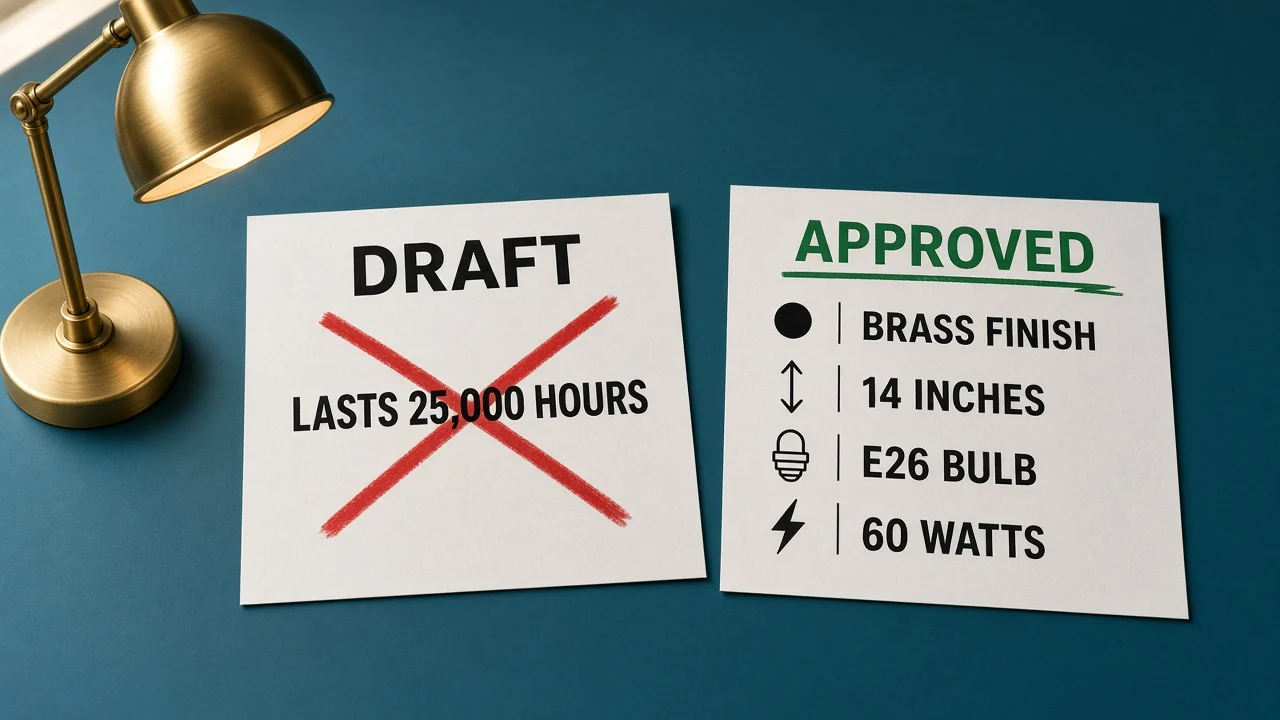
The new lamp page said the bulb lasts 25,000 hours. Nobody on the team had measured that, and the supplier sheet did not say it either. AI product descriptions for ecommerce wrote the sentence because a lamp description "usually" mentions lifespan.
This example record only knows four facts: brass, 14 inches, an E26 bulb, and a 60 watt maximum.
What are AI product descriptions for ecommerce?
They are draft text produced from the product record, for a person to accept or reject before anything publishes. The model may arrange facts you already stored. It may not add a spec, a lifespan, or a performance claim that the record does not contain.
The FTC's advertising FAQ says advertisers must have proof to support their claims, and that a money-back guarantee is not a substitute for that proof. A fluent paragraph is not proof. If you cannot point to the watt, the height, or a test you actually have, the sentence does not ship.
What is the draft allowed to use?
LAMP-14's record, labeled as an example:
| On the record | A draft may say | A draft may not say |
|---|---|---|
| Finish brass | Brass finish | Antique brass, unless that is the stored value |
| Height 14 in | 14 inches high | A room-size claim |
| Bulb E26 | Takes an E26 bulb | That you include a bulb, unless the record says so |
| Max watt 60 | 60 watt maximum | LED lifespan, energy savings, or a brand of bulb |
The sentence you can defend is short. "Brass finish, 14 inches high, E26 bulb, 60 watt maximum." That is the whole description until someone adds a fact to the record on purpose.
A longer page is fine when the extra words are arrangement, not new claims. "This desk lamp has a brass finish and stands 14 inches high" restates the record. "This energy efficient LED lasts 25,000 hours" invents two claims. Delete both, even if the rest of the paragraph is usable.
What do you delete before anyone publishes?
Read the draft against the table, not against how nice it sounds.
| Draft sentence | Decision |
|---|---|
| Brass finish, 14 inches high | Keep |
| E26 bulb, 60 watt maximum | Keep |
| Lasts 25,000 hours | Delete. Not on the record. |
| Energy efficient LED | Delete. The record does not say LED, and it does not say efficient. |
| Perfect for any room | Delete. You did not define the room. |
Then look for a soft version of the same trick. "Designed for long evenings" is not a number, and it is still a claim you would not enjoy defending.
Cut it. The FTC FAQ is about proof for claims, including ones that need objective evaluation. Atmosphere is your call. A measurable promise is not.
Shopify's PIM guide lists multiple versions of product content as a limit of editing inside one store. The approved sentence can be shortened for one channel. It cannot grow a new fact on the way to that channel.
Who is allowed to press publish?
The person who can see the record, not the person who likes the prose. If those are the same person on a small team, still do the pass as two steps: write, then check the table. Publishing from the generation screen skips the check.
A catalog of 40 lamps does not need a committee. It does need the same reject list on every lamp, or lamp 12 stays honest and lamp 13 grows a lifespan.
I would not turn on a bulk publish that writes straight to the live theme. Generate into a draft field. Accept. Then send.
AI product information management in OneChannelAdmin is where that draft sits next to the specs. The page shoppers see is multichannel commerce. What you can still ship is inventory management, which a description must not invent. The Shopify copy of an accepted sentence uses the Shopify integration.
How do two channels share one approval?
Amazon, in this example, gets the four facts in a tighter line because the title already carries the brand and the size. Shopify gets the same four facts as the product description. You do not ask the model for a fresh essay per site. A fresh essay is how the 25,000-hour line appears on only one of them.
If a channel's limit cuts the watt maximum, do not ship the shorter line. Watt max is one of the four facts. Shorten by removing repeated words, not by dropping a spec.
Price does not belong in the generated description if price is a channel override. An $80 example retail price will be wrong on a trade store the same day you paste it into the paragraph.
What belongs in the prompt?
The fields, and the instruction to use only those fields. A competitor's product page does not belong there. "Make it exciting" does not belong there. Exciting is how a lifespan shows up when the sheet had a watt limit.
When height changes from 14 in to 15, the accepted sentence is stale on purpose. Edit the number, or generate again from the updated record.
Leaving 14 in the prose after the spec says 15 is the same class of error as inventing 25,000 hours. One of them was never true. The other stopped being true.
Keep the rejected sentences for a week. If the same lifespan line returns on the next lamp, the prompt is still asking for it, or someone is pasting an old draft forward. Fix the prompt. Do not keep deleting the same sentence by hand and calling that a process.
The black lamp does not inherit the brass sentence. Generate from the black record, or you will publish a brass description on a black product because the draft was handy. Same watt and same bulb can be copied only if those fields match. Finish cannot hitch a ride.
Do not ask the model to hit a word target by adding adjectives. A demand for 150 words is how "timeless" arrives. If a channel wants more length, add a fact to the record first, then generate. Empty length is a claim waiting for a shopper.
Read the live page with the spec table beside it. Search for numbers. The only numbers you should find are 14 and 60, until height becomes 15. Any other number was invented or left from an old draft.
E26 is a fact. "Standard bulb" is a paraphrase that fails in a shop with more than one base. Prefer the stored token over a friendlier synonym. If the search finds 25,000, take that sentence off the live page before you rewrite the prompt.
Do that before anyone pays to send a shopper to the page.
How do you approve one description?
- List the facts on LAMP-14. In this example: brass, 14 in, E26, 60 watt max.
- Generate a draft from those fields only. Do not paste a competitor's page into the prompt.
- Strike any sentence that adds a spec, a lifespan, a savings claim, or a room the record does not mention.
- Keep a version you could read aloud next to the spec table without apologizing.
- Store that version on the record. Map a shorter line only by cutting repeated words.
- Publish. Search the live page for a number that is not on the record.
Stop on step 6 if 25,000, LED, or "energy" appears. The draft was not approved. The page was.

Questions about generated product copy
Can you publish the first draft?
Not if you have not checked it against the record. The first draft is a proposal. The live page is a claim.
What if the model sounds like your brand?
Voice is not accuracy. A sentence can sound like you and still invent a lifespan. Check the facts after you check the tone.
Should every channel get a new paragraph?
No. Approve one set of facts. Shorten for a tight title by dropping repeated words. Do not regenerate from scratch and hope the new paragraph stays inside the spec.
Does a money-back offer cover a bad claim?
The FTC's advertising FAQ says a money-back guarantee is not a substitute for proof. You still need the fact on the record, or a test you can show.
Where should the accepted text live?
On the product record, next to the specs it was checked against. A doc in someone's inbox will not update when height changes from 14 in to 15.
OneChannelAdmin Team writes about draft descriptions, the specs they are allowed to use, and the sentences that should never reach a product page.
Run inventory, orders, and marketplaces in one place
See how OneChannelAdmin connects catalog, warehouse, and multichannel selling without spreadsheet chaos.