



3PL Warehouse Management Software That Separates Clients
What is 3PL warehouse management software?
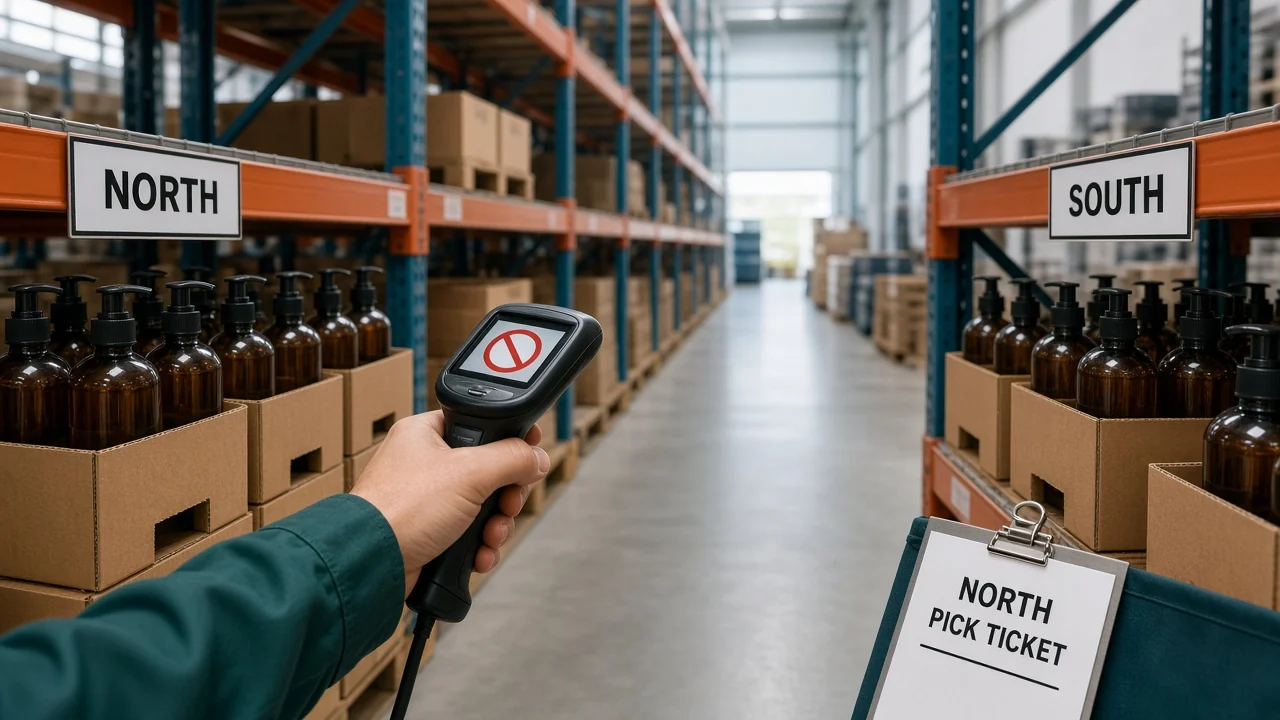
It runs receiving, bins, picks, packs, and counts for more than one client at once. Each unit knows its owner. A pick for North cannot decrement South. Receipts, picks, and storage days become that client's invoice without a Friday spreadsheet.
If the software has one on-hand number per sku and no client on the row, it is a single-brand WMS with extra logins. You will mix stock the first week two brands share a barcode.
How is a client different from a warehouse?
A warehouse is a building. A client is an owner inside it. East and West can each hold North and South. Four piles, not two.
North
South
East
30 units in E-N-01
12 units in E-S-01
West
10 units in W-N-02
40 units in W-S-03
North's East order may take E-N-01. It may not take E-S-01, even if the bottle looks identical and the barcode text matches. The client is part of the identity.
A transfer of North's goods from West to East is North's stock moving. It is not a chance to "borrow" South's 12 because East looks short. Borrowing is how you spend the afternoon writing credits.
What should the scan do to the invoice?
The same scan that proves the work should price it. Otherwise you do the job twice: once on the floor and once in a sheet.
Example rates, not a price list you should copy. A receipt is $5 a carton. A pick is $1.50. Storage is $0.40 a bin a day.
North's Tuesday: 4 cartons received and 80 units picked. They also occupied 15 bins.
Receipts are 4 times $5, which is $20. Picks are 80 times $1.50, which is $120. Storage that day is 15 times $0.40, which is $6.
Tuesday's activity is $146, and it should tie to those scans. If a sheet says 100 picks and the scanner says 80, bill 80 and find the missing 20.
South never sees North's $146. Their portal shows their orders, their bins, and their invoice. A shared login where South can scroll into North's sku list is not a portal. It is a leak.
The GAO inventory count guide describes counting a portion on a schedule so on-hand numbers stay fit to manage with. Run that per client. A building-wide count that is "close enough" can still have North long and South short by the same amount.
The drive after the carton exists is a different system. Gurobi's routing FAQ is about which stops each vehicle visits and in what order. A cleaner route will not stop a pick that takes South's bottle for North's label.
Which jobs are the software's, and which are not?
Job
The 3PL system has to do this
You can bolt on later
Identity
Client on every row, bin, and pick
A pretty client logo on the portal
Billing
Rates applied to scans, one invoice per client
A custom peak-season clause
Orders
Each client's orders, tracked back to their channel
A new marketplace every week before the first client is stable
Counts
Cycle count inside that client's bins
A robot that counts the aisle
A client portal that shows yesterday's spreadsheet upload is a website in front of the same problem. They should see the bin quantity the picker sees.
3PL management in OneChannelAdmin covers multi-client inventory, orders, and invoicing from the warehouse flow. The bins themselves are warehouse management. Quantities per client live in inventory management, one number for North and another for South. The building that ships the pick is order fulfillment.
When is a single-brand WMS enough?
You only store your own goods. The moment a second company pays you to hold theirs, the client field stops being optional.
I'd rather delay that client a month than import them into a system that cannot refuse a cross-client scan. Also wait on a tool whose billing is a monthly export you retype. You will miss the $6 of storage, and then you will miss it every day.
What has to be true before a client goes live?
Their sku file needs a barcode, a unit of measure, and the client id on every row. A csv of product names and nothing else becomes the unlabeled carton problem on day one.
Send them ten test units, not their whole catalog. Receive those ten into their bins.
Place one order and pick it. Show them the invoice lines those scans created. If they cannot see only their ten units in the portal, stop and fix the filter before the pallet shows up.
A client who wants you to store "whatever arrives" without a file is asking you to invent their catalog at the dock. That is a project rate, or it is a no.
What does a bad import do to the bill?
Map both bottles to one barcode and North's 4 cartons land in a shared pile. The $20 receipt line can still look right. The pick will not. Eighty North picks can decrement South, and Tuesday's $120 is labor you did for the wrong owner.
Fix the barcode before you debate the storage rate. The $6 of bins is real only if those 15 bins belong to North. A shared location billed to both clients is double rent on one shelf. The client who notices will not care that the scanner was fast.
If the portal shows South a North order, the separation test already failed. Do not go live to clean it up next week. Next week is a pallet, and that pallet will use the same wrong barcode. Show North the $146 Tuesday example before the rest of the catalog lands.
Bill the bin-days you scanned, not a square-foot guess typed on Friday. Fifteen bins at the example $0.40 is $6 because the location record said North occupied them that day. An empty bin you still bill is rent for air.
A full bin never assigned to North is storage you gave away. Empty bins are not a favor, and unlabeled full bins are not free. Show North that sample Tuesday figure in writing before go-live.
How do you test it with two fake clients?
Create North and South. Put the same-looking bottle in E-N-01 and E-S-01 with different owners.
Receive 4 cartons for North only. South's on-hand must not move.
Pick one unit for a North order. The scan of E-S-01 must fail.
Confirm Tuesday's math can be produced from scans: $20 receipts, $120 picks, $6 storage.
Open South's view and confirm North's order is not on the screen.
Cycle count E-N-01. A miss adjusts North only.
Stop on step 3 if the wrong bin scans. Billing features will not fix a pick that steals another client's unit.
Questions about software for a shared warehouse
How is this different from a normal WMS?
A normal WMS can run one owner's building. 3PL software adds the owner to every unit, blocks picks across owners, and prices the scans onto that owner's invoice. Without the owner, two brands become one pile.
Can two clients use the same barcode?
Only when the client is stored with the sku and the pick rejects the other client's bin. E-N-01 and E-S-01 can hold similar bottles. A North pick that accepts E-S-01 is a failed test.
How should storage be billed?
From bin-days you can point at, times the rate on that client's card. In the example, 15 bins at $0.40 is $6 for the day. Do not estimate storage from a monthly average if the scans exist.
What should a client be allowed to see?
Their orders, their bins, and their invoice. Not the other client's sku list. A shared screen is how a competitor learns what you store for someone else.
What is the first test that matters?
Two owners, one similar bottle, and a pick that fails on the wrong bin. If that scan succeeds, do not onboard the second real client.
OneChannelAdmin Team writes about multi-client bins, picks that stay with the right owner, and invoices built from those scans.
Scale Your Multi-Channel Commerce Operations with 1CA
Discover how OneChannelAdmin unifies inventory management, WMS warehouse operations, order fulfillment, and automated marketplace repricing.