
Ecommerce Fulfillment
Software
Ecommerce fulfillment software automates order imports, inventory allocation, split shipments, tracking updates, and customer notifications across sales channels.
Ecommerce Fulfillment is best for
- 3PLs fulfilling marketplace and storefront orders
- Clients selling on Amazon, Shopify, eBay or Walmart
- Operations splitting orders across warehouses
- Teams managing per-channel shipping promises
Ecommerce Fulfillment Software
Ecommerce fulfillment software automates order imports, inventory allocation, split shipments, tracking updates, and customer notifications across sales channels.
Unified workspace
Centralizes warehouse, inventory, orders, and client records.
Role permissions
Controls access for operators, supervisors, and clients.
Queue visibility
Shows inbound, picking, packing, and shipping workloads.
Status tracking
Tracks receiving, putaway, fulfillment, and delivery stages.
Audit history
Records edits, exceptions, and workflow changes.
Multi-site support
Manages warehouses and client sites consistently.
API connectivity
Integrates marketplaces, carriers, and billing systems.

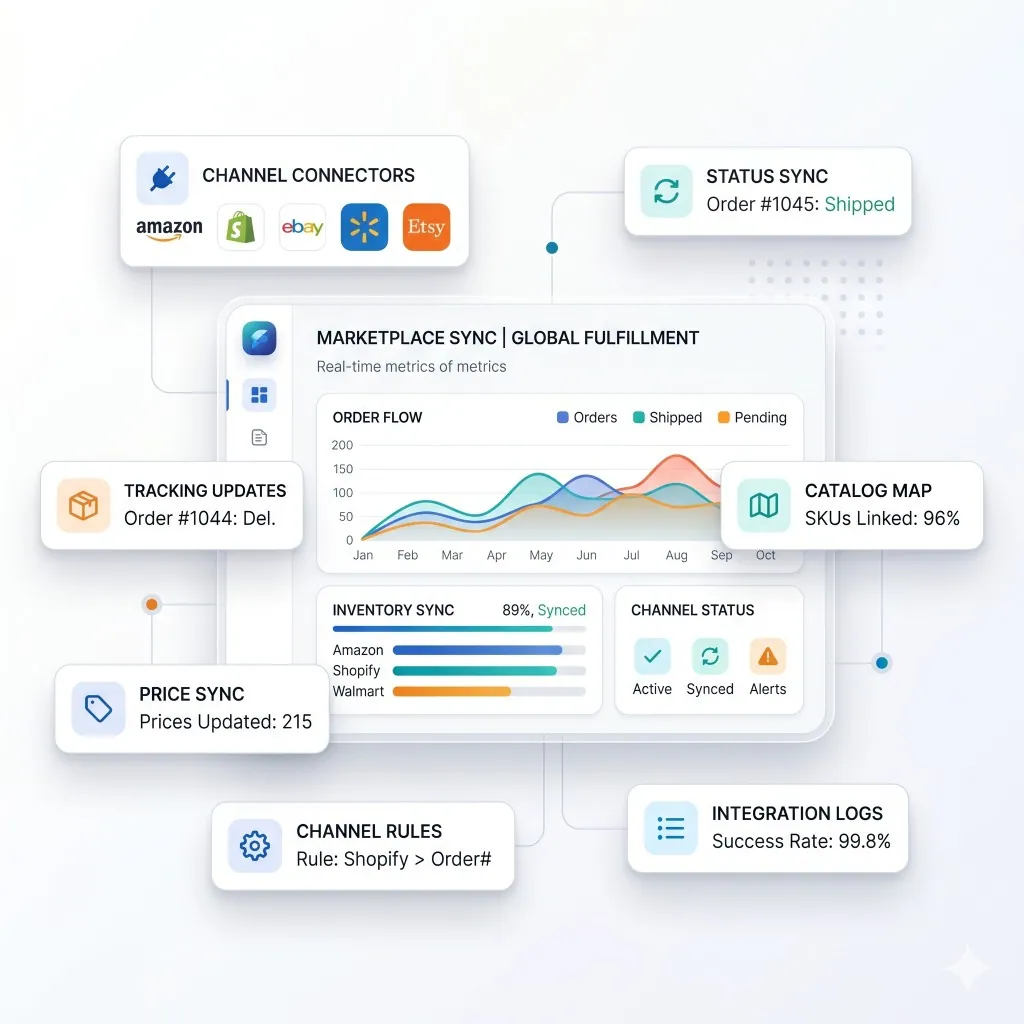
Channel Integrations
Connect Amazon, Shopify, eBay, Walmart, and other marketplaces with status sync.
Order import
Pull orders from every connected channel into one queue.
Channel-specific rules
Honor the shipping and handling terms each channel advertises.
SKU mapping
Resolve channel listing identifiers to the warehouse SKU.
Marketplace acknowledgement
Confirm receipt where the channel expects it before shipping.
Status write-back
Return shipment and tracking to the channel that sold it.
Buyer data handling
Respect what each channel permits to be stored and for how long.
Multi-store support
Run several storefronts or seller accounts through one queue.
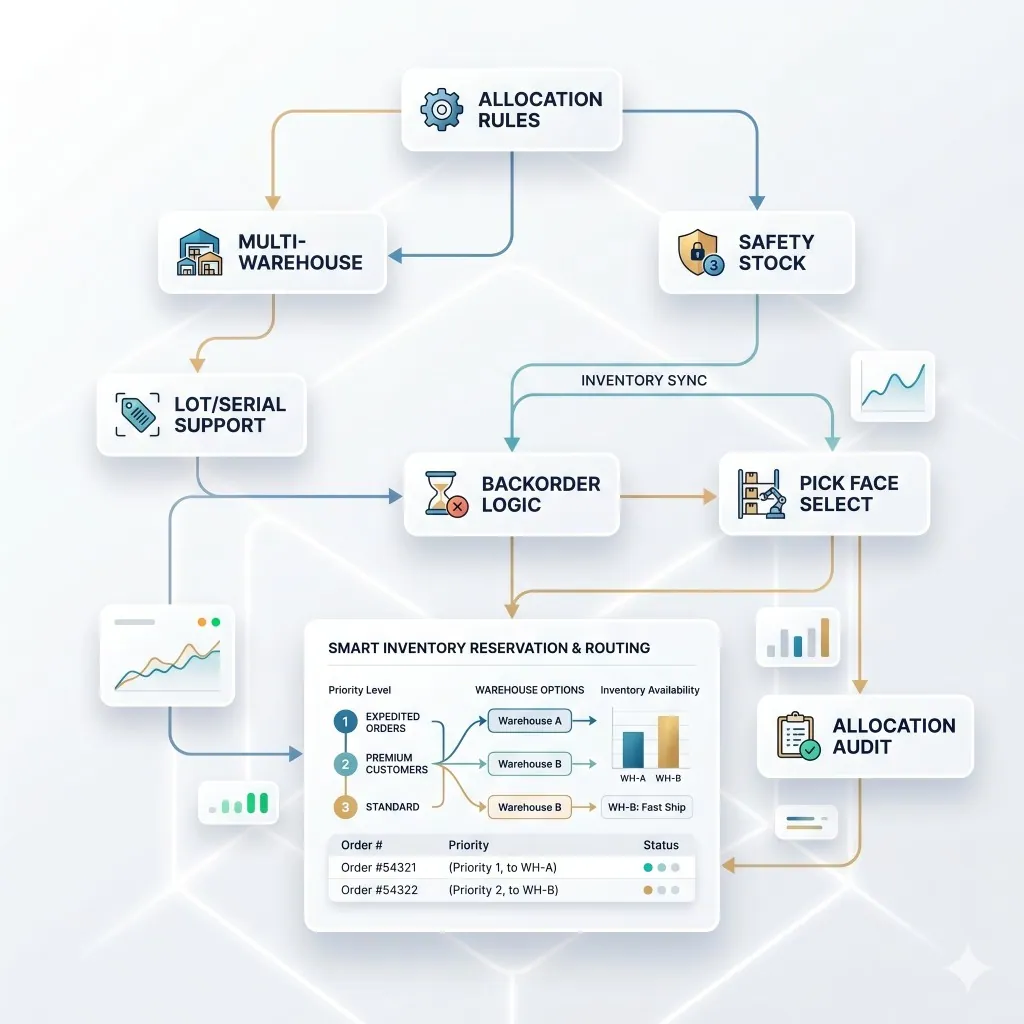
Smart Allocation
Route inventory with safety stock, multi-warehouse rules, and backorder logic.
Ship-from selection
Choose the warehouse by distance, stock, and cost to serve.
Safety stock buffers
Hold back a reserve so fast channels cannot drain the shared pool.
Backorder rules
Decide per client whether to hold, split, or cancel on shortfall.
Reservation on import
Commit stock at import so two channels cannot sell one unit.
Priority ordering
Let expedited and SLA-bound orders jump the queue.
Inbound awareness
Allocate against stock arriving today, not only stock on hand.
Re-allocation on failure
Move a line to another site when the first cannot fill it.

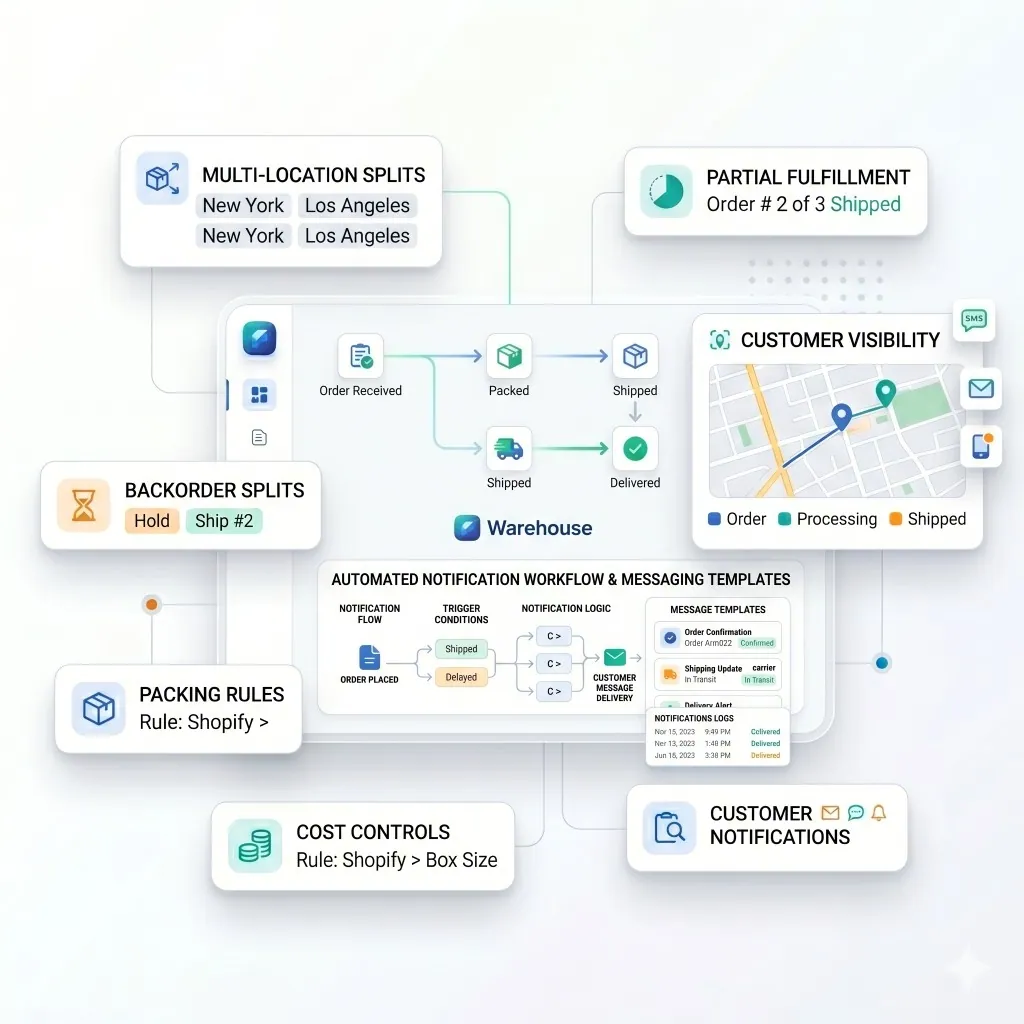
Split Shipments
Manage partial fulfillment, multi-location splits, and customer visibility.
Multi-site splits
Fulfill one order from two warehouses without cloning it.
Partial release
Ship what is available now and keep the balance open.
Per-parcel tracking
Give each parcel its own tracking against the same order.
Customer messaging
Explain a split so it does not read as a missing item.
Consolidation holds
Wait briefly to ship complete where that is cheaper overall.
Channel split rules
Apply the split policy each marketplace tolerates.
Shortfall escalation
Raise a split that will breach an SLA before it does.
Ecommerce Analytics
Track channel performance, fulfillment speed, and exception rates.
Order-to-ship time
Measure elapsed time per channel, not just per warehouse.
Split rate
Track how often orders ship in parts and what it costs.
Oversell incidents
Count how often a channel sold stock that was not there.
Channel mix
See volume and margin contribution by marketplace.
Late shipment rate
Measure against the promise each channel published.
Cancellation causes
Separate stock shortfalls from buyer-initiated cancellations.
Cost per shipment
Compare landed fulfillment cost across channels.
Why teams choose Ecommerce Fulfillment Software
Ecommerce fulfillment software automates order imports, inventory allocation, split shipments, tracking updates, and customer notifications across sales channels.
One queue for every channel
Marketplace and storefront orders work the same way on the floor.
Fewer oversells
Reservation at import keeps channels from selling the same unit.
Splits that make sense
Partial shipments follow a policy rather than a warehouse decision.
Promises kept per channel
Performance measured against what each channel advertised.
Channel-by-Channel Fulfillment vs 1CA Ecommerce Fulfillment
A capability comparison, not a competitor list. This is how 1CA handles Ecommerce Fulfillment versus disconnected tools.
Channel-by-Channel Fulfillment
- A separate export and import per sales channel
- Two channels selling the same last unit
- Split shipments decided ad hoc on the floor
- Tracking pasted back into each channel by hand
1CA Ecommerce Fulfillment
- Every channel lands in one queue with SKU mapping resolved
- Stock reserved at import so channels cannot oversell
- Split, hold, or backorder applied as a per-client rule
- Shipment and tracking written back to the selling channel
Frequently Asked Questions
Answers to common operational inquiries.