
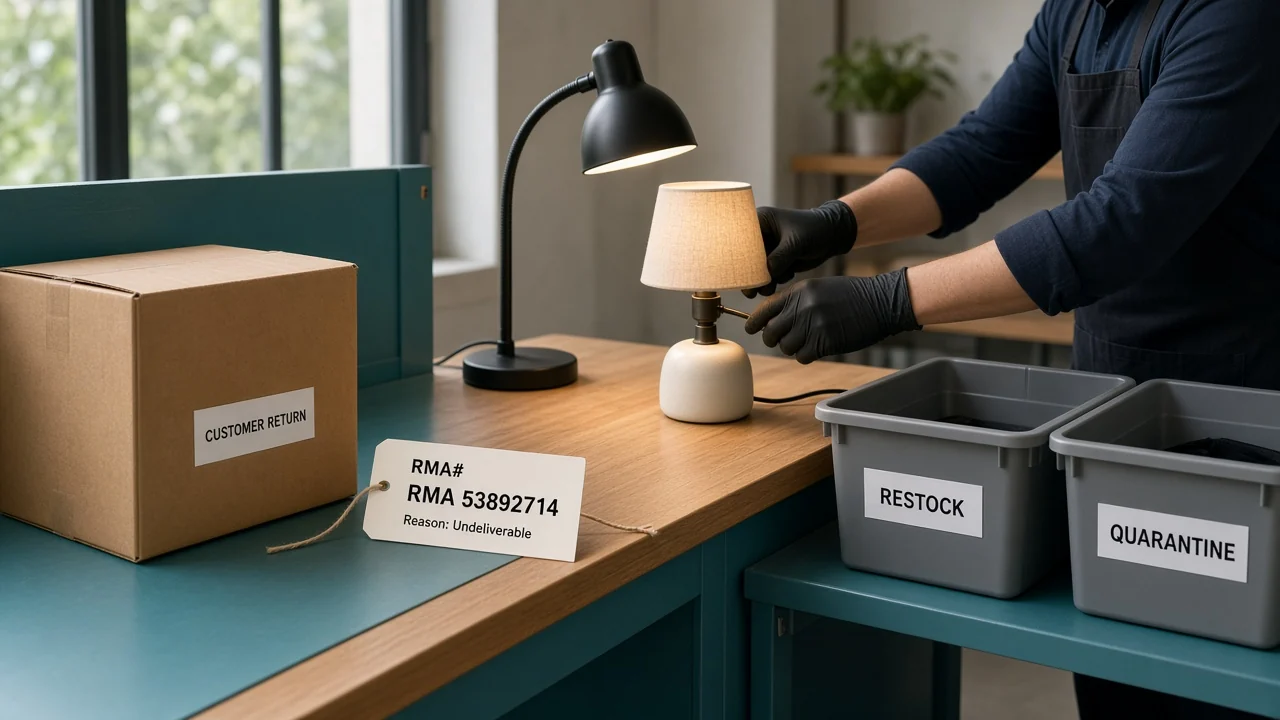
The lamp came back in a crushed carton with no number on the label. Someone scanned it into the sellable bin because the order history showed a return. The next buyer received the broken one.
An RMA process is the gate in front of that bin. The customer gets an authorization number first. The dock receives against that number. Nothing becomes available until a person has looked at it.
What is an RMA process?
It is how you approve a return, tag it with a number, and decide what happens after it arrives. Shopify's RMA guide describes the sequence stores already recognize: the customer asks, the item gets a number, they get instructions, they ship, you assess the unit, then you refund or replace.
The number is the point. Without it, the dock is guessing which order came back and whether you agreed to the return at all.
What do you check before you issue the number?
Match the request to the order and to the rule you already published. This example is order 1044, one lamp, delivered 12 days ago, inside a 30-day window you chose. The reason they typed is "changed my mind."
That request can be approved. You are approving the trip home, not the condition of the lamp.
Send RMA-1044-1, the return address, and the last date you will accept the carton. State that a refund waits on inspection if that is your rule. Say it in the same message as the number, not after they have paid for a label.
If the window has closed, do not invent a number to be nice and then refuse the carton. Refuse in writing, with the date.
What happens when the carton hits the dock?
Receive only cartons that show RMA-1044-1. A carton with no number goes to a hold shelf, not into stock and not into the trash. Log the tracking if you have it, and ask the customer for the number before anyone opens a refund.
Open RMA-1044-1. The lamp is cracked, and the reason code said it was a change of mind. Those are different facts.
Take a photo. The disposition is damage, not a return to the pick face.
Available stock of that lamp was 12 before the return. Leave it at 12. If you add the return on arrival, you publish 13 and you can sell a unit you cannot ship in one piece.
| What you see | Where it goes | What the customer gets |
|---|---|---|
| Right item, resellable, policy allows it | Sellable bin after inspection | Refund or exchange, per the rule you sent |
| Right item, opened but still sound | A separate open-box location, not the new-goods count | Refund, and a lower price if you resell it that way |
| Cracked, incomplete, or the wrong sku | Quarantine. Do not add it to available | A decision after the photo, not an automatic restock |
| No RMA number on the carton | Hold shelf | No refund until you match it to a number |
The GAO inventory count guide treats physical checks as support for the on-hand quantity people use to make decisions. A return is one of those checks. The book quantity should change when you know the unit is sellable, not when the truck arrives.
Who closes the RMA?
The dock records condition. A second step releases the money or the replacement. The same person should not scan a crushed lamp into available and also push the refund, if you can split those jobs.
Close RMA-1044-1 like this: do not restock, and follow the damage rule you wrote. If your rule refunds damage from the outbound trip, refund and keep the photo for the carrier. If your rule refunds only resellable returns, tell the customer what you found.
Say why the outcome changed. Silence after a photo is how a chargeback starts. Then close the number. An open authorization from last quarter is a carton you are still pretending might arrive.
Where an RMA process usually breaks
The break is almost never the label. Someone busy scans the return into the sellable bin to clear the bench. That scan feels like progress and publishes a unit nobody has looked at.
Keep a quarantine location that cannot be picked and cannot sync to the storefront. RMA-1044-1 lives there until the photo is filed. If a portal lets a customer start a return without a number landing on the dock screen, you will get cartons you cannot match. Fix that join before you add another reason code.
Order fulfillment in OneChannelAdmin can keep the return on the original order. The quantity you refuse to bump until inspection is inventory management. The hold shelf is a bin in warehouse management.
What do you tell the customer while it sits?
They have a number and a carrier scan. They do not have a refund yet, if inspection is your clock. Send one status when the carton hits the dock: received, not refunded, inspection inside a window you can keep. In this example, say two business days.
If you stay quiet for a week, they open a card dispute and you answer with a photo you could have sent on day one. The cracked-lamp photo is the record. The email is that same fact, earlier.
Match the inbound scan to RMA-1044-1 before anyone asks where the lamp went. A "delivered" scan with no number on the bench is the hold shelf. It is not a lost package, and it is not a restock.
Can the replacement ship before inspection?
Yes, when it comes from the 12 lamps you already trust. Shipping a new lamp does not require the cracked one to become unit 13. Decrement those 12 only when the replacement leaves. The return stays in quarantine until the photo is filed.
Waiting to ship until the return is restocked makes the customer wait on a unit you will never sell. Shipping the replacement and also adding the return to available gives a lamp away and lists one you do not have. Write the replacement order number on RMA-1044-1 so support sees both.
Do not issue a second number just because the customer replied to an old email. One lamp gets one authorization. The carrier photo stays on RMA-1044-1 beside the refund, so support is still not hunting through two different email threads.
How do you run the first RMA?
Use one order. Do not turn on a portal for the whole catalog until this carton behaves.
- Publish the window and the outcomes you offer: refund, exchange, or decline.
- Approve order 1044 only if it sits inside that window. Issue one number, RMA-1044-1, plus the address and the deadline.
- Receive the carton only if that number is on it. Anything else waits on a hold shelf.
- Inspect. Write the condition. Leave available stock unchanged until this step says the unit can be sold.
- Restock only a sound unit, into the location that matches its condition. Quarantine the cracked lamp.
- Refund, replace, or decline based on the condition and the rule you already sent. Close the number.
Stop if step 4 is skipped. A restock on the inbound scan is the broken lamp in the next box.

Questions about authorizing a return
What does RMA stand for?
Return merchandise authorization. It is the approval to send an item back, plus the number you use to receive it. Shopify's guide walks the same path from the request to the assessment and the refund or replacement.
Should you refund before the item arrives?
Only if your published rule says so. If the rule says inspection first, wait. RMA-1044-1 looked like a change of mind and arrived cracked. An early refund would have paid out before you knew that.
Does a return increase available stock on arrival?
No. Available was 12 and stays 12 until inspection says the unit can be sold. Adding it on the dock scan publishes a unit you may not be able to ship.
What do you do with a carton that has no number?
Put it on a hold shelf. Do not restock it and do not refund it. Match it to an RMA number before it enters the normal flow.
Who should be allowed to restock a return?
Someone who did not also approve the refund, when you have two people. The dock writes the condition. The close of the RMA applies the rule. One login that does both will hide a cracked unit inside a refund.
OneChannelAdmin Team writes about return numbers, hold bins, and the stock you can still sell.
Run inventory, orders, and marketplaces in one place
See how OneChannelAdmin connects catalog, warehouse, and multichannel selling without spreadsheet chaos.