
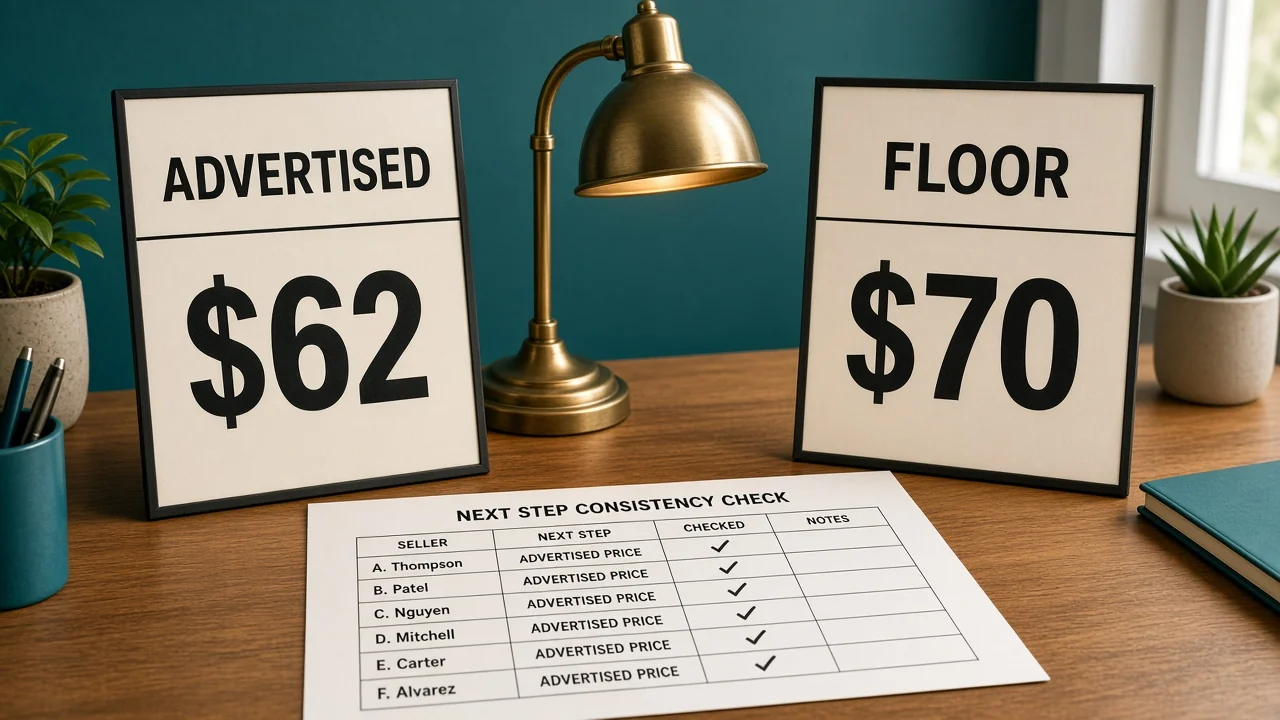
A seller showed the lamp at $62. Your published floor is $70. The account team wanted a quieter email because that seller buys a lot. MAP policy enforcement is the same next step you would use for a seller who buys little.
That special exception is how the floor becomes a suggestion.
What is MAP policy enforcement?
It is you comparing the price a shopper can see with the advertised floor in your own policy, then taking the next step that policy already lists. It is not a negotiation. This page is an operations checklist, not legal advice.
The FTC's guide on manufacturer-imposed requirements says the law allows a manufacturer considerable leeway in setting the terms for advertising it helps pay for, in answer to a question about a minimum advertised price on a co-op program. The same guide says manufacturer-imposed vertical price programs are evaluated under a rule of reason. Do not read a blog, including this one, as clearance to set anyone's selling price.
The number you are enforcing here is the advertised price. In the example, that is $70. A reply that says "you can show $62 if you pay us cash at $70" is a different deal. Do not invent it in the notice thread.
What do you compare, and what do you leave alone?
LAMP-14, example MAP $70. The page shows $62 before checkout. The gap is $8. That gap is the violation you can describe.
| What you saw | Compare it to $70? | Why |
|---|---|---|
| $62 on the public listing | Yes | A shopper sees it before checkout |
| $74 on the listing, $62 only after login in the cart | Not until your policy says so | The public ad may still be $74. Ask counsel before you treat the cart as an ad. |
| Your own coupon for $5 off a $74 price | Only if the price a shopper sees is under $70 | Do the subtraction. $74 minus $5 is $69. |
| A marketplace-funded badge you did not create | Record it, name the source | The seller may not have typed $62 |
Amazon's Automate Pricing tool moves the price shoppers see, inside a minimum you set. If you also sell the lamp, your displayed price is an advertisement of your own. Put $70 in as that minimum so your rule is not the violation.
What is the same for every seller?
| Step you already wrote | What "the same" means |
|---|---|
| Notice | Seller, SKU, URL, $62, $70, time, and a screenshot |
| Cure window | The hours in the policy. If you wrote two business days, use two business days. |
| Next step | Whatever the policy lists next. Not a new punishment invented in the email. |
| Who may send it | The people the policy names. Not the reseller who complained. |
A large account does not get a shorter window. A new account does not get a harsher one because you are annoyed. Inconsistent steps are how a floor starts to look like a favor.
MAP monitoring in OneChannelAdmin is the log of that comparison. A floor you also have to obey on your own offer sits with repricing. The Amazon page you captured is the Amazon integration. Units in the building stay in inventory management and are not a reason to advertise $62.
What should the notice not become?
Do not ask the seller what MAP "should" be. Do not copy another reseller on the thread so they can pile on. Do not agree, in writing, that $62 is fine this week if they raise a different SKU.
The FTC guide's rule-of-reason point is about vertical price programs, and it is a legal standard, not a script. The operations version is simpler: you published a floor, you saw an advertised price, you follow your sheet. You do not workshop the floor with the people you sell to.
If the policy is silent on the next step, stop and write the step before you send a threat. A notice that says "we might do something" trains sellers to wait you out.
What happens when the window ends?
Look at the same URL. Do not take the seller's reply as the price. If the page shows $70 or more, close the row as complied and keep the screenshot of the fix. If it still shows $62, take only the next step your policy already lists.
Do not add a day because they asked nicely in the thread. The window is the one you published. Extending it for one seller means the next seller can quote that email. If you want a longer window, change the policy, then use the new window for everyone from that date forward.
A second gap on a different SKU is a new row, not a reason to skip the cure on LAMP-14. Work the open row first. Sellers learn the order you actually follow, not the order in the PDF nobody saw applied.
When you stop supply, say which SKU and for how long, in the words the policy uses. A vague "we're reviewing the relationship" is not a step. It is a pause that lets $62 stay up while you think.
Store the closed rows where a new hire can open them without asking you. Seller, SKU, first price, fixed price, dates. If the only copy is in one person's inbox, the next violation will be handled from memory, and memory is how the big account gets the quiet email again.
Count open rows every Monday in this example, not because Monday is magic. An open row older than the cure window is a step you skipped and never wrote down. Either take that step or record why the policy's clock stopped. "We meant to" is not a why.
A seller who fixed LAMP-14 and broke a second SKU the same week is not a success story. Close the first row. Open the second. The floor is per SKU, and so is the file.
Print the policy date on the notice. A seller still using last year's number is not violating today's $70 until you actually sent today's floor. The row should name the policy version. If you cannot find the version, you are enforcing a figure that lives in one person's head.
Two coworkers should reach the same next step from the row alone. If they pick different threats, the written step is too vague to send. Tighten the policy before you send either version.
Then run the next notice from that tighter line only, including the large account. Write the new line into the policy the same day. Do not leave the wording in a chat.
How do you enforce one advertised price?
- Confirm the policy names $70 for LAMP-14 and names the next step.
- Capture the public price, the URL, the seller, and the time. Keep the screenshot.
- Subtract. $70 minus $62 is $8. Write $8 on the row.
- Check whether a coupon or the marketplace moved the price. If the seller's own figure is $74, do not notice them for $62.
- Send the notice your policy already uses. Include the cure window you wrote.
- When the window ends, look again. Complied goes to a closed row. Not complied takes only the next step already listed.
Stop on step 4 if you cannot name who set $62. A notice to the wrong party is not enforcement.

Questions about enforcing an advertised floor
Does MAP set the price in the cart?
Not by the way this checklist uses the word. You are looking at the price a shopper can see advertised. Whether a cart price is an advertisement is a question for the policy and for counsel. Do not guess it in the notice.
Can you skip a seller who buys a lot?
No. The same gap gets the same step. A private exception is how $70 stops being the floor.
What if your own listing is the one at $62?
Treat it as your violation. Raise the displayed price to the floor, and set that floor as the minimum in any repricer. You do not get a quieter process than the sellers you notice.
Who is allowed to discuss the violation?
The people named in your policy, with that seller. Do not run the conversation through another reseller.
Is this legal advice?
No. The FTC guide is the place to start reading, and a lawyer is the person who tells you whether your policy matches it. The $70 and $62 figures are an example.
OneChannelAdmin Team writes about advertised floors, the same next step for every seller, and the screenshot a notice has to include.
Looking for the product? See MAP Monitoring & Enforcement.
Run inventory, orders, and marketplaces in one place
See how OneChannelAdmin connects catalog, warehouse, and multichannel selling without spreadsheet chaos.