
A friend asked you to ship their soap from the spare bay. The second brand showed up with the same-looking bottle and no barcode of its own. By Friday you had picked North's order from South's cartons.
How to start a 3PL business is mostly that problem, on purpose. You store and ship someone else's goods, and you bill them for the work. The first month should prove you can tell the clients apart.
How to start a 3PL business in one bay?
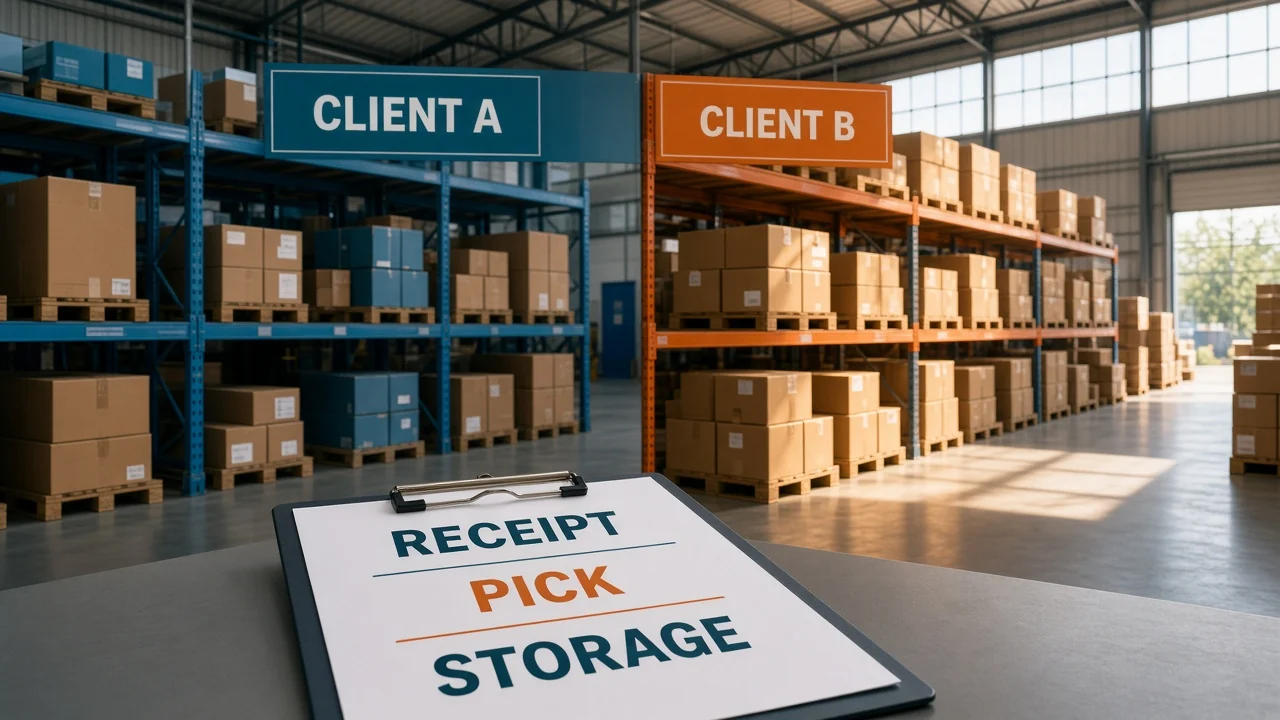
Pick one kind of client and one building. Receive their goods into bins that carry the client name, ship their orders, and invoice from those scans. A garage can do this for a single brand. It stops working when a second brand shares a shelf and a spreadsheet.
You are not a carrier on day one unless you put the goods on your own truck. Many new warehouses buy postage and hand the carton to a parcel carrier. If you will hire, or you need a business tax number, the IRS EIN page is where that number starts.
Which clients should you refuse at first?
Take one shape of work. Small cartons, a barcode on every unit, and orders that ship the same day. That is a lane you can write a procedure for.
Say no, for now, to the work that needs a different building. Cold food, hazmat, floor-loaded furniture, and a retail compliance label you have never printed. Each of those is a real business. It is a second business.
| The ask | In the first 90 days | Later |
|---|---|---|
| One brand, cartons, barcodes, parcel shipping | Yes, if you can separate their bins | Keep them as the template |
| A second brand with the same process | Yes, after the first brand's count matches | Same rate card, new bins |
| Kitting, relabeling, or returns | Only if the rate card names the fee | Add the line before you do the work |
| Freight, cold storage, or hazmat | No | A different slot, insurance, and procedure |
I'd rather lose a flashy lead than learn hazmat on their first pallet. Write the no down so you do not renegotiate it in the inbox.
What belongs on the rate card?
Every fee needs a unit. If the unit is fuzzy, the invoice becomes an argument.
Use example rates, not a market survey. Receiving is $5 a carton. A pick is $1.50 a unit. Storage is $0.40 a bin a day.
A quiet month still has a $2,000 minimum, because the bay is yours whether they sell or not.
Say the month produces 20 received cartons, 600 picks, and 40 bins occupied all 30 days.
| Line | Math | Amount |
|---|---|---|
| Receiving | 20 cartons times $5 | $100 |
| Picks | 600 times $1.50 | $900 |
| Storage | 40 bins times 30 days times $0.40 | $480 |
| Activity total | 100 + 900 + 480 | $1,480 |
| Monthly minimum | Example floor | $2,000 |
You bill $2,000, not $1,480. The $520 gap is the minimum doing its job. Tell the client that before the first pallet, not when the invoice shocks them.
Materials, a special project, and a return each get their own line. If it is not on the card, it is a favor, and favors do not scale past one friend.
What does the first receipt look like?
The client emails a tracking number and a spreadsheet. The carton arrives with no sku label. Count the bottles if you want, but do not guess them into a pick face.
Guessing is how 24 bottles become 20 in their store and 28 on your shelf. Park the carton in a location named INBOUND-HOLD. It is not available to pick.
Send a photo and the count you will sign for. When they confirm, print their barcodes, scan into N-12, and only then let the store sell those units.
If unlabeled inbound sits for two days, that wait is a project when your card says so. Call it free storage and you train them to skip labels. Charge the example storage rate in week one anyway, so the habit exists before a second client arrives.
Who may change a quantity?
Only a named person, with a reason the client could read. The picker who cannot find a bottle should not zero the bin and keep walking.
A miss becomes a count. The count finds the bottle or adjusts with a note. If everyone can edit on-hand, the invoice and the storefront drift, and you will not know which scan lied. One adjustment login is enough while you are small.
How do you keep two clients' stock apart?
North has 80 units of a bottle. South has 50 of a bottle that looks the same. The location is not "soap." It is North, bin N-12, and South, bin S-04.
A pick for North can only scan N-12. If the scanner accepts S-04, you have one pool and two angry brands. Prefix the sku with the client, or store the client on every inventory row.
That shared barcode in one bin is how you ship the wrong owner's goods.
The GAO inventory count guide describes cycle counting as checking a portion on a schedule until the stock has been covered, so the on-hand number managers use is not a guess. Do that per client. A perfect building total can still hide a short client.
Count North's bins on a rotation. When the count misses, fix the scan you skipped before you adjust their quantity. Their available number is what their store is selling.
Do not paste one building total onto both stores. North's shop should see North's bins. If you publish 130 bottles into both shops, you have promised 260 units from 130 on the shelf.
Insurance and a local license depend on your city and on the goods. I will not invent those rules here. What does not depend on the city is the split: their units, their bins, their invoice. Put that split on the sheet they sign.
3PL management in OneChannelAdmin is built for that split: more than one client in one warehouse. Bins and picks sit in warehouse management. Each client's quantity is inventory management. The order you are picking is order fulfillment.
What do you hand the first client?
A one-page sheet beats a 40-page contract nobody reads, as long as the page names the work.
- List the services you will do this month. Receiving, storage, pick, pack, and parcel labels. Name what you will not do.
- Put the rate card on the same page, including the monthly minimum and who pays for boxes.
- Require a barcode and a quantity on every inbound carton. Refuse unlabeled mixed cartons or count them as a project.
- Give their units their own bins. Prove a pick cannot scan the other client's bin.
- Ship five real orders. Tracking goes back to their store without you emailing a spreadsheet.
- Invoice from the scans: cartons, picks, and bin-days. Compare it to the rate card before you send it.
Stop if step 4 fails. A second client on top of a shared pile is how the first client leaves.

Questions about starting a warehouse for other brands
Do you need a huge warehouse to start?
No. One bay and one client type is enough if every unit has a client and a bin. Square footage does not fix a shared pile. A second brand with the same process can wait until the first client's count matches the shelf.
What fees should the first rate card include?
Receiving, storage, picks, pack materials, and a monthly minimum. Add a line for projects and returns before you perform them. The example in this article ($5 a carton, $1.50 a pick, $0.40 a bin-day, $2,000 minimum) is an illustration, not a quote.
How do you bill a slow month?
Add the activity lines. If they total less than the minimum you published, bill the minimum. In the example, $1,480 of activity still invoices at $2,000.
Can two clients share a barcode?
Only if your system stores the client on the row and the pick will not scan the other client's bin. The same bottle in one unlabeled location will get shipped for the wrong owner.
When should you add a second service?
After five orders have shipped and the invoice matched the scans. Kitting and returns are reasonable add-ons once they have a price. Cold storage and hazmat are a different operation.
OneChannelAdmin Team writes about client inventory, warehouse bins, and the invoices that have to match the scans.
Run inventory, orders, and marketplaces in one place
See how OneChannelAdmin connects catalog, warehouse, and multichannel selling without spreadsheet chaos.