
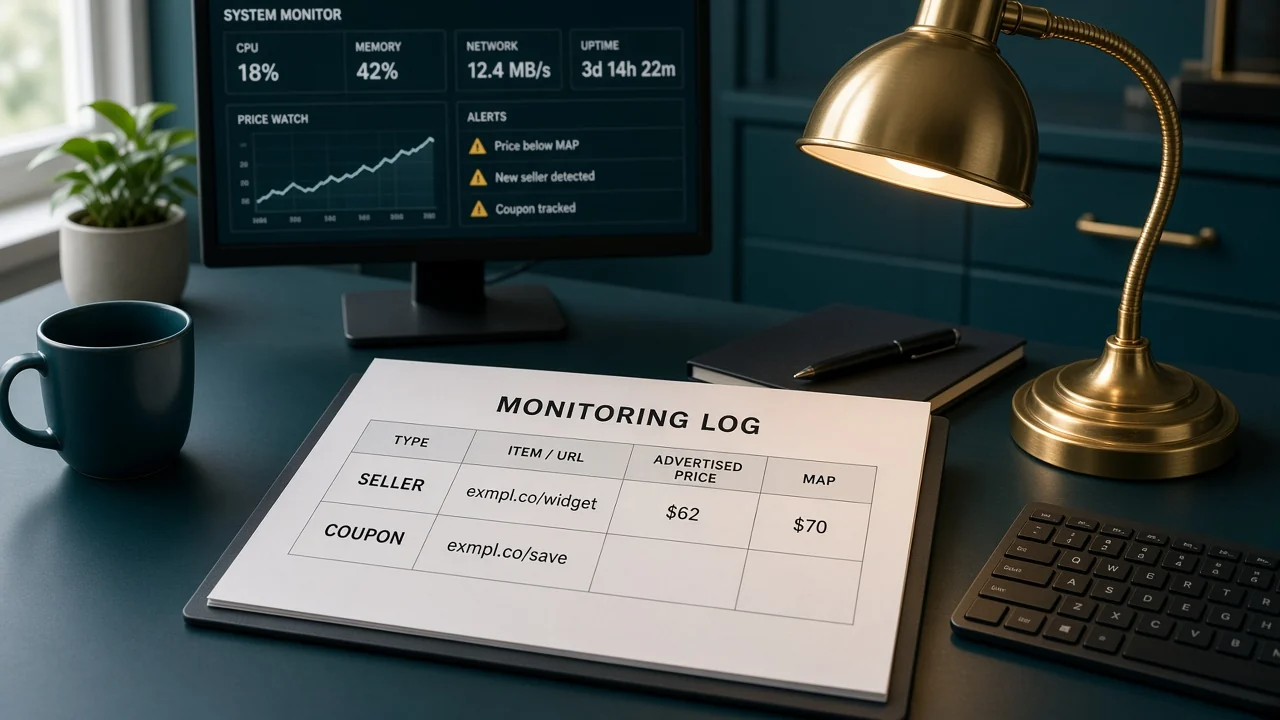
The notice went to a seller for a $62 lamp. The screenshot was a marketplace coupon on a $74 price. The seller had not typed $62. How to monitor MAP violations starts by writing down who changed the number, before anyone gets an email.
A low price without a source is a rumor.
How to monitor MAP violations?
You read the price a shopper can see, compare it with the floor in your policy, and store the row even when you do not send a notice. The row needs the seller, the SKU, the URL, the advertised price, the floor, the gap, the time, and the cause. A cause of "looks low" is not a cause.
This is an operations log, not legal advice.
The FTC's guide on manufacturer-imposed requirements says a manufacturer has considerable leeway in the terms of advertising it helps pay for, including a minimum advertised price in that co-op setting. The same guide says vertical price programs are judged under a rule of reason.
The log does not decide the legal question. It stops you from accusing the wrong person.
What goes on the row?
LAMP-14, example floor $70.
| Column | This example |
|---|---|
| Time | 9:14 a.m., with the date |
| Seller | The name on the offer, not "Amazon" unless Amazon is the seller |
| SKU | LAMP-14 |
| URL | The public page you captured |
| Advertised price | $62 |
| Floor | $70 |
| Gap | $8 |
| Cause | Seller typed it, your coupon, or a marketplace badge |
$70 minus $62 is $8. Write $8. Do not write "a bit under." The next person to read the row should not have to redo the subtraction.
Amazon's Automate Pricing page is a reminder that a displayed price can move because a rule fired, not because a person sat and typed. If the offer is yours, the cause might be your own minimum sitting at $62. Fix the rule and keep the row so you can see that you were the violation.
What is not ready for a notice?
A marketplace coupon can stack onto a compliant $74. Do the math before you blame the seller.
$74 minus a $5 badge is $69, which is under $70, and the cause column says the badge. Your policy might still care about the $69 a shopper sees. The notice has to say that, not "you priced it at $62."
Cart price behind a login is a different capture, when your policy only names advertised prices. Save the screenshot of the public page. Ask counsel before the cart becomes its own violation type. Do not invent that line in the spreadsheet today.
Your repricer. If you matched $62, the monitor did its job by catching you. The fix is the minimum, not a notice to a rival.
How often is often enough?
For a catalog of about 40 SKUs you sell under a floor, twice a day is a workable example, not a standard. Morning catches overnight rule changes. Late afternoon catches the promotions a marketplace turns on after lunch.
A 2,000-SKU catalog will not survive as screenshots in a folder with no SKU in the filename. The row is the product. The image is evidence attached to the row. One without the other is how you send last month's $62 to a seller who has been at $74 for three weeks.
I check the SKUs that were under the floor yesterday before I sample the quiet ones. Repeat gaps are where a notice is already late. A first dip might be a coupon that ends at midnight.
MAP monitoring in OneChannelAdmin is that row across channels. Your own offer's minimum sits in repricing. The Amazon page you opened is the Amazon integration. Stock level is not the advertised price, and it stays in inventory management.
What do you do with a clean row?
You still keep the clean row. A seller at $74 against a $70 floor is compliance, and you will want that line when someone claims you only write down bad news.
Same columns. The gap is zero, or the price is over the floor. Cause can be blank.
Do not delete a violation row after they fix it. Close it. The history is what shows you treated the next seller the same way.
Who touches the log?
One person owns the rows. Someone else can send notices, but they send from the row, not from a forwarded screenshot with no gap written on it. If the cause cell is empty, the notice waits.
Once a week, count the rows by cause. You are not looking for a magic percentage. You are looking for a pile.
If most of the under-floor rows are marketplace badges, more notices will not change the price. Change how coupons are allowed, or stop treating badges as seller typing.
When the pile is your own rule instead, the monitor is working and the minimum is not. Fix the floor before you add a second daily pass. Another pass will only photograph the same $62.
A seller who is under on three SKUs gets three rows, not one angry paragraph that mixes the gaps. $8 on LAMP-14 is not the same fact as $2 on a different lamp. The notice can list them. The log should not merge them.
Name the page type in the row when a site shows more than one price. "Listing" and "banner" are different lines if both are public.
A banner at $62 over a $74 listing is still a price a shopper sees. Capture the banner. Do not average the two numbers into $68 and call the gap small.
Keep the image next to the row the same day. A screenshot from Thursday attached to a Wednesday price is how you accuse someone of a number that was already fixed. The time on the row and the time in the image should match.
If you cannot open last month's file and find LAMP-14 in under a minute, the log is a folder, not a monitor. Sort by SKU. The notice process can stay slow. The lookup cannot.
Review a sample of ten closed rows each month in this example. You are checking that the cause was filled in and that the screenshot time matches the row. A closed row with no image is only a memory, and memories drift toward the story you prefer.
Pull one row at random. A stranger should be able to tell who set the price. If they cannot, the cause cell failed.
How do you check one listing?
- Open the public page for LAMP-14. Ignore the cart until your policy names it.
- Read the price a shopper sees without signing in. In the bad example, $62.
- Write the row: time, seller, SKU, URL, $62, floor $70, gap $8.
- Name the cause. Seller price, your coupon, marketplace badge, or your own rule.
- If the cause is the seller and the gap is real, the row is ready for whatever notice your policy already uses.
- If the cause is not the seller, do not send that notice. Fix the coupon or the rule, and keep the row.
Stop on step 4 if the cause is a guess. A guess is how the coupon screenshot becomes an accusation.

Questions about watching advertised prices
Is a low price always a violation?
No. Compare it with the floor and name who set it. A marketplace coupon on a $74 price is a different row from a seller who typed $62.
What if the listing is yours?
Log it the same way. Then raise your minimum so the rule cannot show $62 again. You are not exempt from the floor you publish.
Should you email every low price the same hour?
Send a notice only when the cause is the seller and your policy says to send one. The log can be immediate. The email waits on the cause column.
Do you keep rows that are over the floor?
Yes. Close the bad rows when they are fixed, and keep the compliant ones. The point is a record of the same check, not a folder of only the fights.
How often should you look?
Twice a day is an example for a short list of floored SKUs. It is not a rule. Look again sooner at any SKU that was under the floor yesterday.
OneChannelAdmin Team writes about advertised-price logs, the cause column, and the notice you do not send until that column is filled in.
Looking for the product? See MAP Monitoring & Enforcement.
Run inventory, orders, and marketplaces in one place
See how OneChannelAdmin connects catalog, warehouse, and multichannel selling without spreadsheet chaos.