
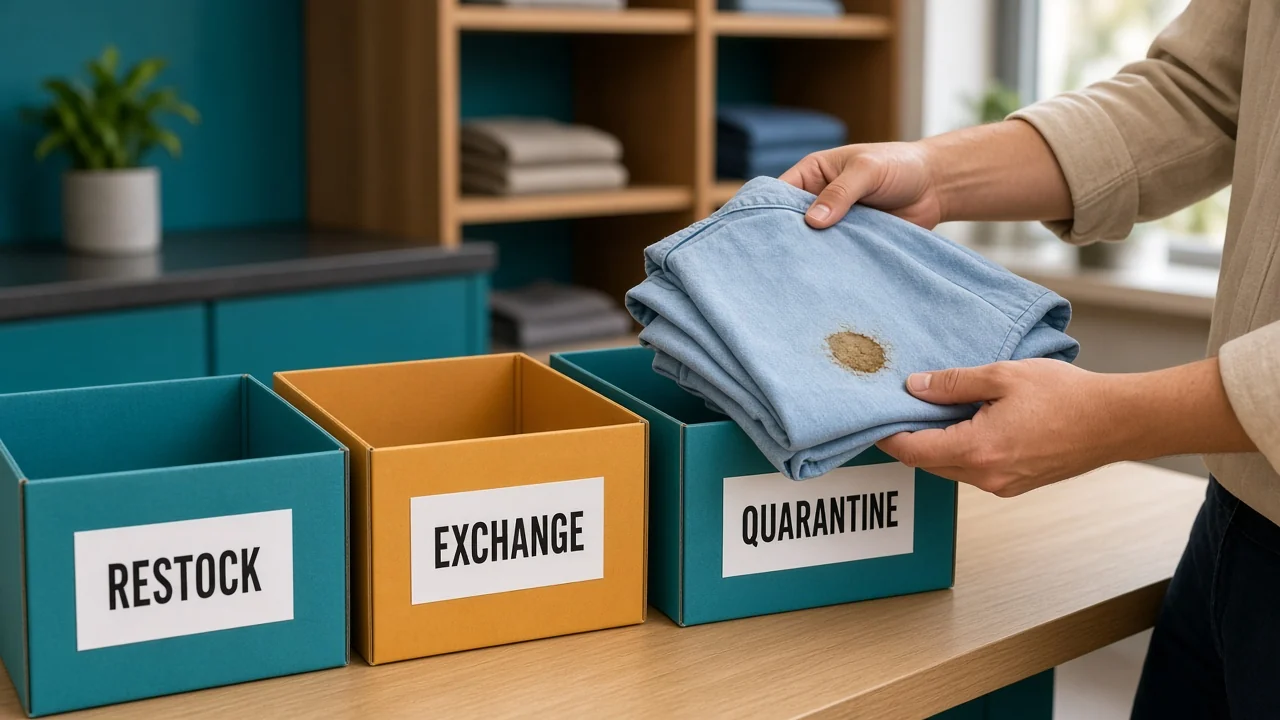
The shirt came back a size too small. The refund went out the hour the label was scanned by the carrier. The shirt arrived a week later with a stain, and available stock had already gone up by one.
Ecommerce returns management is the set of decisions around that shirt: whether it may come back, who pays the label, when money moves, and whether the unit can be sold again. The truck ride is only the middle.
What is ecommerce returns management?
It is the policy plus the warehouse work. You approve the return, send a label, inspect, then refund, exchange, or decline. Shopify's RMA guide lays out that arc: a request, a number, instructions, the shipment, an assessment, then the refund or replacement.
Reverse logistics is the carton moving toward you. Returns management is that trip plus the money and the stock decision. If you only buy a label and restock on the scan, you have the trip and none of the control.
When should the refund actually happen?
Pick one clock and publish it. These are policy choices, not a statute.
| Clock | What the customer feels | What you risk |
|---|---|---|
| Refund when the label is created | Fast, and easy to abuse | You pay before you know the shirt is in the box |
| Refund when the carrier first scans the return | Still fast | The stain is a week away, and the money is gone |
| Refund when you inspect | Slower, and honest | You must say so up front, and you must inspect quickly |
For a $40 shirt, an example label costs you $8. If you refund $40 at the first carrier scan and the shirt cannot be resold, you are out $48 plus whatever you paid for the unit. If inspection shows a clean shirt, you still spent $8, and you put the unit back only after you see it.
An exchange is often the better close. They wanted a medium and you sent a small.
Ship the medium from stock you already trust. Do not wait to restock the stained small before that medium can leave. The exchange is a new shipment, and the return stays a separate inspection.
Where does the shirt go after you open it?
Available was 20 mediums before this return. It stays 20 until the shirt is clean, complete, and in a sellable bin.
A stained small does not become a medium, and it does not become a 21st unit of anything. Quarantine it. If you later sell it as a damaged discount, that is a different sku or a different location, with a price that matches the stain. Folding it into the new-goods count is how the next order gets the photo that does not match the shirt.
The GAO inventory count guide is about keeping on-hand numbers reliable enough to manage with. A return that increments available on the inbound scan breaks that number on purpose.
Reason codes are the other half. "Too small" on a shirt you listed as a medium is a content problem. "Stained" is a warehouse or a carrier problem.
"Changed my mind" is a sale you may not want to chase with a looser policy. If every return is coded "other," you cannot fix the listing or the pack-out.
What should the 3PL be allowed to do?
If someone else receives your returns, write the clocks into the agreement. How many days from dock to inspection. Which conditions they may restock without calling you. Who presses the refund.
A building that restocks to be helpful will inflate the medium count with shirts you have not seen. A building that waits for an email on every carton will miss the refund you promised in five days. Give them a table like the one above, and a quarantine bin that is not pickable.
Order fulfillment in OneChannelAdmin can keep the return tied to the original order and the exchange that replaces it. Stock stays put until inspection in inventory management. The quarantine bin lives in warehouse management. A 3PL receiving for several brands needs the client on that return, which is 3PL management.
Which returns should you refuse up front?
Publish the window and follow it. This example uses 30 days from delivery, which is your policy choice, not a federal rule. A request on day 45 gets a written no, with the delivery date in the message.
Final sale and worn items need the same treatment. If the listing said no returns, approving one in the portal teaches the next buyer to try. If the shirt comes back with the tag cut off, inspection can still decline the refund when that is the rule you wrote.
Keep the declined request on the order so support does not approve it again from a different inbox. Quarantine is for cartons you accepted and cannot sell. A refused request should not become a carton you were not expecting.
A second label on the same order is another example $8. Do not send it because the first email bounced. Look up the number you already issued. Two open returns for one shirt is how available drops, jumps, and drops again when both cartons show up.
What should you do with reason codes each month?
Pull the codes for that shirt, not a building-wide pile. If "too small" is half the returns, the size chart is the fix, and a looser refund clock will not help. If "stained" clusters on one pack station, watch that station pack the next ten orders.
"Changed my mind" at a steady rate is the cost of the policy you chose. Track the label dollars beside it. In the example, each of those returns costs $8 before you look at the shirt. Ten of them are $80, which is two shirts at the $40 price, whether or not you restock.
When the exchange ships, decrement mediums, not smalls. The small is still in quarantine. If the exchange pick waits on the return, you can ship the stained shirt as the replacement.
Support should see the reason code on the order, not in a chat that disappears. Next month's size-chart fix depends on that field still being there.
If the 3PL's agreement says inspection in two days and your refund clock says five, the date on the product page has to be the slower one. Promising five days and inspecting on day seven means you broke your own page. Say the slower date out loud.
How do you process one return without corrupting stock?
- Publish the window, who pays the label, and which clock triggers the refund.
- Approve the request and send one return number. Decline anything outside the window in writing.
- When the carton arrives, receive it against that number. Do not add a unit to available.
- Inspect. Clean and complete goes to the sellable bin for that size. Stained or wrong goes to quarantine.
- If the close is an exchange, ship the replacement from stock you already had. Do not wait on the bad unit.
- Refund only on the clock you published. Store the reason code on the sku, not in a note nobody reads.
Stop if step 3 increases available. The rest of the returns will quietly do the same.

Questions about handling online returns
How is returns management different from the return shipment?
The shipment is the carton coming back. Returns management adds the approval, the refund clock, the inspection, and the choice to restock, quarantine, or exchange. A label by itself does not decide any of those.
Should you refund when the carrier scans the return?
Only if that is the clock you published. It is fast, and it pays out before you see a stain. Inspection-based refunds are slower and match the unit you actually got back.
When can a return increase the quantity you sell?
After inspection says it is complete and you put it in a sellable bin. In the example, 20 mediums stay 20 while a stained shirt sits in quarantine. A dock scan is not a restock.
Is an exchange better than a refund?
When you have the right size in trusted stock, ship that exchange without waiting on the bad unit. You still inspect what came back. The exchange does not skip the quarantine.
What should you track besides the refund amount?
The reason code and the condition. "Too small" points at the listing or the size chart. "Stained" points at packing or the carrier. A code of "other" on every return hides both.
OneChannelAdmin Team writes about refunds, exchanges, and the units a return is not allowed to invent.
Run inventory, orders, and marketplaces in one place
See how OneChannelAdmin connects catalog, warehouse, and multichannel selling without spreadsheet chaos.