
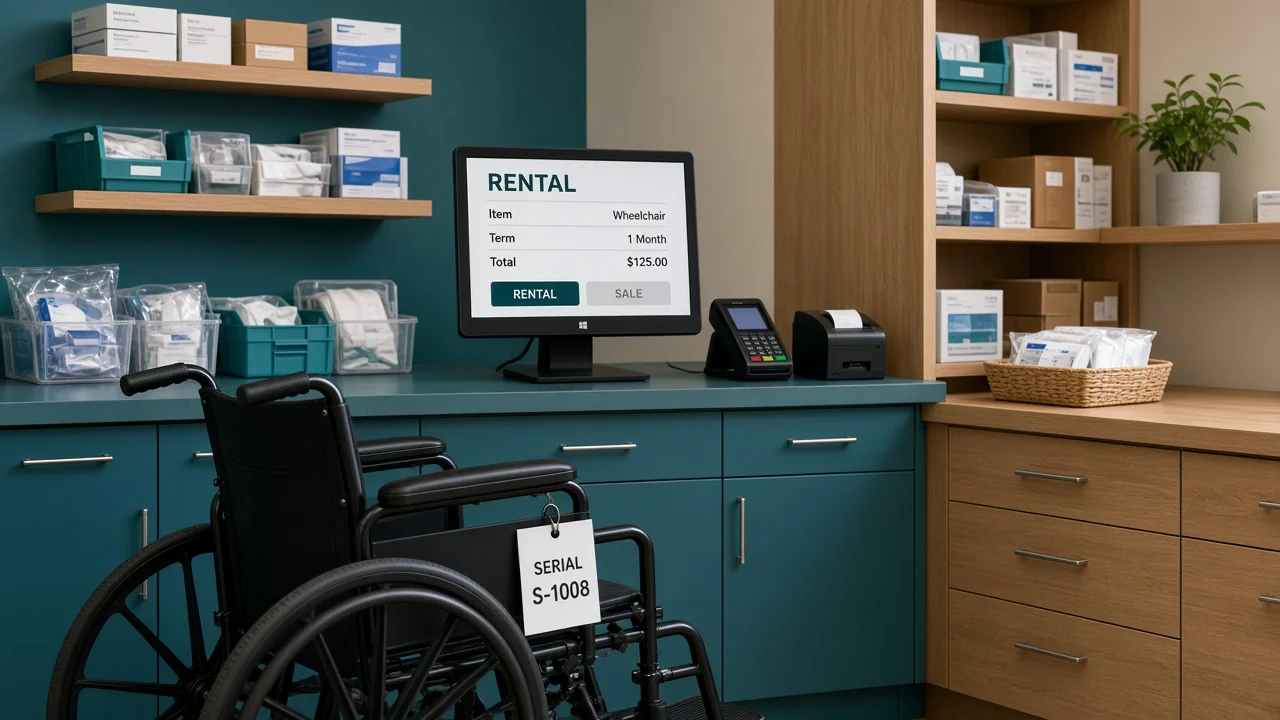
WC-18, serial S-1008, left on a rental. The register rang a sale. The shelf now thinks you sold that wheelchair, and the next count will be short one serial. A durable medical equipment POS has to keep the rental ticket separate from the sale ticket.
This is an operations note about the register. It is not Medicare billing advice, and it is not a guide to filing a claim.
What does a durable medical equipment POS record?
It records who received the item, which serial left, whether the ticket is a sale or a rental, and the date a rental is due back. The receipt is not a claim. Coverage, coding, and what a payer will allow are a later step with its own rules. The register's job is to stop the building from losing the chair.
CMS describes durable medical equipment as equipment that can withstand repeated use, has an expected life of at least 3 years for items classified as DME after January 1, 2012, is primarily used for a medical purpose, generally is not useful without an illness or injury, and is appropriate for use in the home. All five conditions have to be met for that classification. Your ticket does not decide the classification. It records what you handed over.
CMS enrollment guidance says suppliers who want Medicare reimbursement have to be accredited, enroll as a DMEPOS supplier, and post a surety bond of $50,000 for each NPI. Those are enrollment facts. They are not buttons on a sale screen. A register cannot substitute for them.
How is the rental ticket different from a sale?
| Sale | Rental | |
|---|---|---|
| Serial S-1008 | Leaves your stock as sold | Stays on your asset list, status out |
| Due back | No | A date you write on the ticket |
| Example money | A sale price you set | Example monthly rent $90, not a fee schedule |
| Next count | You should not find this serial | You should still own this serial |
The $90 is an example so the ticket has a number. It is not a Medicare allowed amount. Do not copy it onto a claim.
On a sale, quantity of that SKU drops and the serial is no longer yours. On a rental, quantity available drops because the chair is out, and the serial remains yours until check-in. Those are different inventory events. Using the sale key for both makes the asset ledger and the sales ledger lie in opposite directions.
A supply that is consumed, such as a filter that does not come back, can be a sale or an issue-out. Do not force it onto the wheelchair's rental ticket as if it were the same kind of thing. Give it its own line so the return of S-1008 does not "return" a filter the patient used.
What has to happen at the counter?
Identify the person or account, then the serial, then the ticket type. If the paperwork in front of you is a rental, the key is rental even when someone is paying the first month at the counter. Taking $90 and hitting sale feels faster. It is how S-1008 vanishes.
Read the serial on the frame, not the model on the box you think you grabbed. Two WC-18 chairs can sit in the same bay. Selling or renting "a wheelchair" without S-1008 means the other serial is now a mystery when the family calls.
Rental records should hold the out status and the due date. Inventory should show that serial as unavailable, not as a unit you sold. OneChannelAdmin is useful here when the counter and the asset list are the same system, so the sale key is not the only key that can move a serial.
If the chair is already out on another ticket, the register refuses a second rental. One serial, one open rental. A second ticket means you scanned the wrong frame or the first return was never closed.
What mistake loses the wheelchair?
The sale key. After that, the sales report shows revenue for a chair you still expect to get back, and the asset list no longer has S-1008. The night count cannot fix the category. Someone has to reverse the sale and open the rental, then explain the books.
A quieter miss is a return with no serial check. Any WC-18 comes back, you set "a chair" to available, and S-1008 is still on a porch. Scan the frame. If the serial does not match the open ticket, do not close it.
Do not store the only copy of the ticket in a drawer. The due date has to be searchable.
In this example the rental is due on the 24th of the following month. A list of open rentals due that week is the work queue. A shoebox is not.
Customer records hold who has the chair. The serial without a name is a loss. The name without a serial is a guess when two rentals are open.
How do you ring one rental?
- Confirm the ticket type is rental before you take payment. Do not start on the sale key.
- Scan serial S-1008. If that serial is already out, stop and scan the frame again.
- Attach the account and the due date. In this example the due date is the 24th of next month.
- Enter the example rent of $90 as rent, not as a product sale.
- Save, and confirm the asset status is out, not sold. Available count for WC-18 drops by one.
- On return, scan S-1008, match it to this ticket, inspect it, then set the status back to available.

If step 5 shows a sale, reverse it before the customer leaves. Fixing a sold serial a week later means the chair may already have been promised to someone else.
Delivery orders can take the chair to the home. The delivery stop does not convert the rental into a sale. Status stays out until the return scan.
What does the driver carry?
The driver needs the serial, the account name, and the due date. They do not need a claim form, and you should not hand them a code cheat sheet. Their job is to match S-1008 to the rental ticket at the door.
If the family says the chair in the hallway is the one being picked up, the driver still scans the frame. A different serial means a different ticket. Swapping chairs in the van without a scan is how two rentals trade identities and both due dates become fiction.
Delivery does not flip the ticket to a sale. Status stays out. Payment collected on the route, if you collect the example $90, posts to the rental. The driver should not have a sale key on the handheld "for when the card machine is fussy."
On pickup, the same scan closes the loop. Note damage before the van leaves the driveway. A scratch discovered back at the shop cannot be tied to that stop if nobody wrote it down. The chair then sits in limbo, neither available nor clearly still on rent.
Bring the open-rental list for that day, not the whole company file, if the route is short. In this example one stop is S-1008. A list of forty open serials on a phone is easy to tap wrong. Filter to today's work.
When the driver returns without the chair because nobody was home, the ticket stays open and the due date does not move by itself. Someone has to choose a new attempt. An automatic "extend a week" hides misses until the month-end list is a surprise.
Questions about the register
Is the receipt a Medicare claim?
A receipt records the ticket. It is not an electronic claim, and this article does not tell you how to file one. Enrollment, accreditation, and the $50,000 surety bond per NPI are CMS supplier requirements, separate from the sale key.
What if the patient pays the first month at the counter?
Take the money on the rental ticket. Payment does not change the ticket type. Hitting sale because cash is in the drawer removes serial S-1008 from the assets you own.
Can two tickets share serial S-1008?
One open rental per serial. A second ticket means the first return was not closed or the scan picked up a different chair. Do not override it to finish the line.
Where does the $90 come from?
It is an example amount so the rental line is visible. It is not a payer fee schedule. Use the rent you actually charge, and keep claim rules in your billing process.
Does a used filter come back with the chair?
The filter was consumed. Close the chair's rental only for serial S-1008. Do not expect the filter to return to stock when the frame does.
OneChannelAdmin Team writes about registers, serials, and rental tickets that have to stay distinct from sales.
Run inventory, orders, and marketplaces in one place
See how OneChannelAdmin connects catalog, warehouse, and multichannel selling without spreadsheet chaos.