
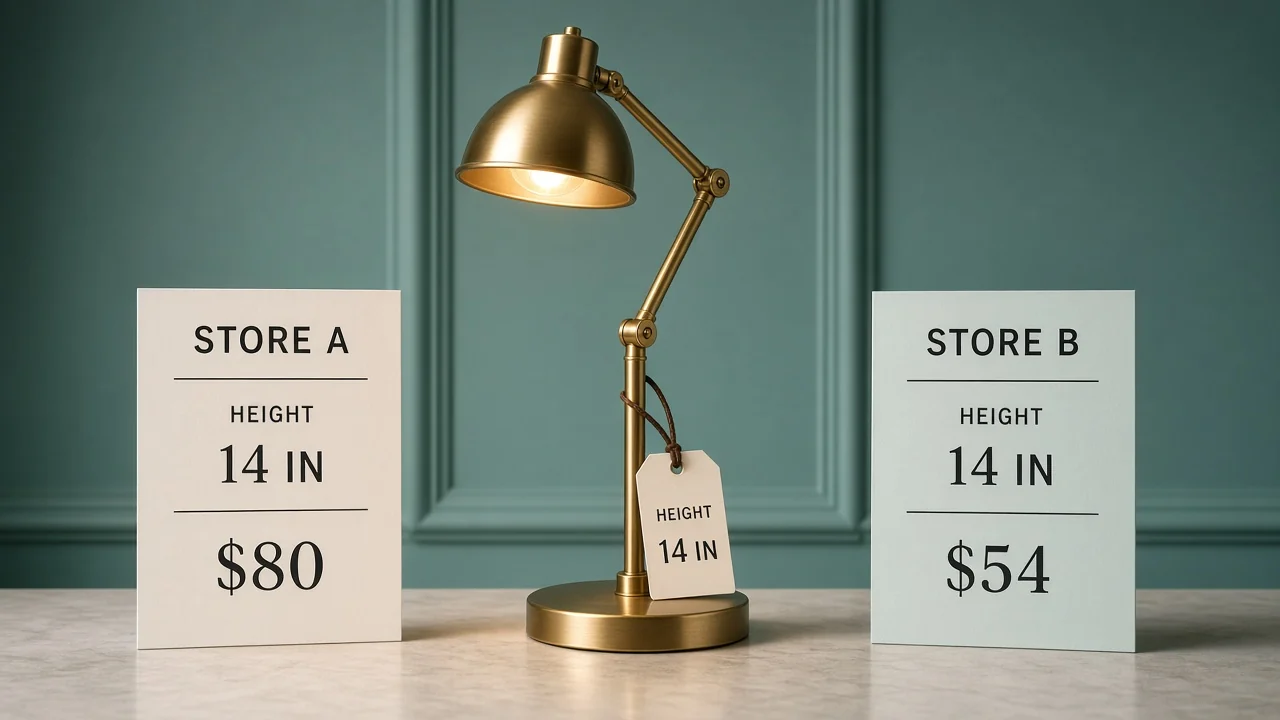
The US store says the lamp is 15 inches. The trade store still says 14. A buyer who shops both will notice before you do. PIM for Shopify is the record both stores publish from, so a spec change is one edit.
Two Shopify admins and a spreadsheet between them will recreate this every season.
What is PIM for Shopify?
It is one product record that publishes into each Shopify store, with a short list of fields allowed to differ per store. Shared specs move together. A price or a title you marked as an override stays local. Height is not on that override list.
Shopify's PIM guide says that adding products, updating prices, and using metafields is not a dedicated PIM system. The guide names the strain: more than one channel, more than one version of the content, and bulk updates. A second store is a second version, even when both stores are Shopify.
What can the store hold without being the catalog?
Shopify's metafields docs describe metafields as custom fields on Shopify resources, stored as a namespace, a key, a value, and a type. You can put height on the product as custom.height. That helps one store's theme.
A metafield does not, by itself, update the trade store. It does not tell Amazon the height. The field is a place to put a value you already decided. PIM for Shopify is the decision, then the publish.
If custom.height says 15 on the US product and the trade product's metafield still says 14, you have two Shopify facts and no record.
What is shared, and what is an override?
LAMP-14 in this example:
| Field | Record | US store | Trade store |
|---|---|---|---|
| Finish | Brass | Brass | Brass |
| Height | 14 in | 14 in | 14 in |
| Bulb | E26 | E26 | E26 |
| Max watt | 60 | 60 | 60 |
| Title | Brass Desk Lamp | Brass Desk Lamp | Brass Desk Lamp, pack of 2 |
| Price | none, until you set a store price | $80 example | $54 example |
The trade title may say pack of 2 only if that store really sells a pack of 2. The override is the selling unit, not a poetic title. Finish does not become "commercial brass" on the trade store unless you want two finishes.
Change height to 15 in on the record. Both stores should show 15. The $80 and $54 prices stay.
If the US admin is where someone typed 15, and the record is still 14, the next publish will put 14 back, or the trade store will never move. Pick the record as the place height is edited. Close the other door.
When is the Shopify admin enough?
One store, one editor, and no marketplace that needs the same specs. You can live in the admin. Metafields can hold height for the theme. I would not open a second store on that habit.
The drift shows up on a small catalog, not only a huge one. Two stores and one lamp are enough to be wrong. A third destination, Amazon or a wholesale list, makes the admin an even worse place to be the only copy.
Also watch apps that write the description. If an app updates the US product and nothing writes the trade product, you get a 15-versus-14 problem in prose instead of inches. The accepted description should be published, not retyped.
AI product information management in OneChannelAdmin is the record those stores publish from. The Shopify integration is the path into each store. Other channels that need the same specs are multichannel commerce. Units you can ship stay in inventory management, not in the title.
What should a store edit never change?
Price on the trade store can stay local when you marked price as an override. The US title can stay local for the same reason. A collection or a tag that only one theme uses can stay on that store.
Shared fields are height, finish, bulb, and max watt. Those describe the lamp. A merchandiser who "just fixes the US page" is editing the lamp for every store that still treats the US page as the master.
Write that list down before the second store launches. After the launch, people will fix the page they can see.
When is a pack of 2 a second product?
The trade title may say pack of 2 when that store sells two lamps as the offer and the specs are still the specs of one lamp. Height stays shared. The pack wording is the override.
Give the pack its own record when it has its own identifier, its own carton weight, or a finish the single lamp does not have. Publishing the pack from LAMP-14's row will push "pack of 2" risks into the US title the moment someone forgets the override flag. A separate SKU cannot forget that flag, because it is not the same item.
Weight is the tell. The single lamp is 4.2 lb in this example. A pack of 2 is not 4.2 lb unless the second lamp weighs nothing.
If both stores show 4.2, the trade page is describing one lamp and charging for two, or the record is describing the pack and the US page is light. Split the records before you split the price.
Also check the theme. If the product page prints custom.height and the description prints the record's height, a shopper can see 14 and 15 on one screen after a sloppy metafield edit. The theme should read the value you publish from the record, not a second number someone typed for a badge.
Before you announce the trade store, open the product as a customer on both domains. Compare finish, height, and watt to the record. Compare price to the override.
A dated screenshot of each page is enough to show they matched once. Save it where the next editor can find it, not in a chat thread that scrolls away.
If the trade theme hides the description and only shows a specs table, that table has to come from the same publish. Last season's metafields will look more official than your record, because they are what the buyer can see.
Check the US domain for the pack title too. The override should not have leaked. If it did, the shared title was edited, and the US store is now selling a pack it does not actually stock.
Fix the shared title before the next publish.
How do you publish one lamp to two stores?
- Create LAMP-14 once: brass, 14 in, E26, 60 watt max.
- Mark title and price as overridable. Leave finish and height shared.
- Set the US title and the example $80 price. Set the trade title, pack of 2, and the example $54 price.
- Publish to both stores. Read height on both. It should match.
- Change height to 15 in on the record only. Confirm both stores show 15, and both prices stayed.
- Try to change height on the US product alone. That edit should not be the source. The record should win on the next publish.
Stop on step 5 if the trade store is still 14. You do not have one catalog. You have two admins.

Questions about a catalog behind Shopify
Is Shopify a PIM if you use metafields?
Shopify's guide says products, prices, and metafields are not a dedicated PIM system. Metafields store custom fields on that store's resources. They do not keep a second store honest.
Can two stores have different prices?
Yes, when price is an override. In the example, $80 and $54 can both be right. Height cannot. A shared spec uses the record.
What if someone edits the product in Shopify admin?
Treat shared fields as read-only, or let the next publish restore them from the record. An admin edit to height that never returns to the record will strand the other store.
Do you need this for a single store?
Not if you are the only editor and you do not sell the SKU anywhere else. The admin is enough until a second store or a marketplace needs the same specs.
Where should the pack-of-2 title live?
On the trade store, as an override, and only if that store sells a pack of 2. Do not write pack of 2 into the shared title or the US store will say it too.
OneChannelAdmin Team writes about shared Shopify specs, the overrides a second store is allowed to keep, and the height that should never drift.
Looking for the product? See AI Product Information Management.
Run inventory, orders, and marketplaces in one place
See how OneChannelAdmin connects catalog, warehouse, and multichannel selling without spreadsheet chaos.