
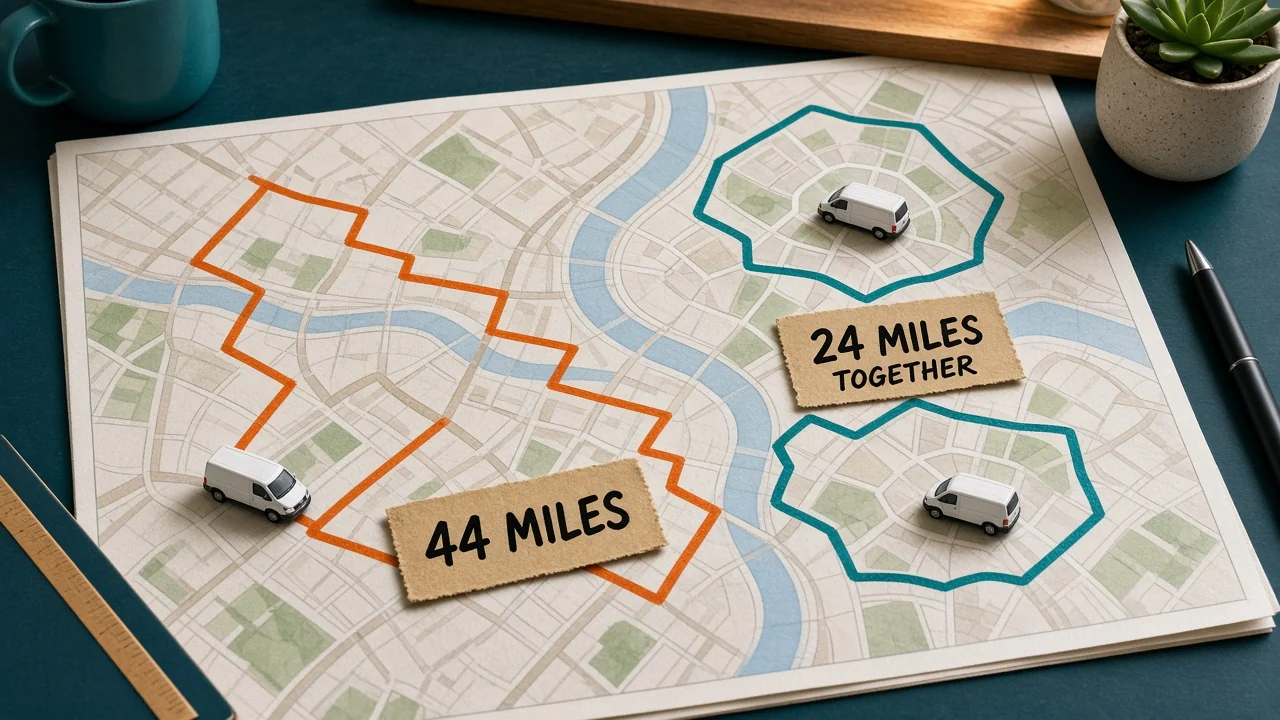
The van left in the order the tickets printed. North, then south, then north again. The driver finished late, and two stops in the same block were an hour apart.
Last mile delivery route optimization is the decision of which stops go on which van, and in what order, before anyone turns the key. A maps app answers a different question: how one driver gets from the stop they are at to the next one they were already given.
What is last mile delivery route optimization?
It assigns stops to vehicles and sequences them under rules you can name. Gurobi's routing FAQ says the vehicle routing problem asks which stops each vehicle visits, in what order, and when. Capacity and time windows can make a short map line illegal.
A single-vehicle tour that visits every stop and returns is the smaller case. The moment you have two vans, you also decide the split, not only the sequence.
What does a bad sequence cost on a tiny map?
These miles are an example you can redraw, not a city average. The depot sits between two neighborhoods.
Stop A is 4 miles north of the depot. B is 1 mile past A, so 5 miles north of the depot. C is 6 miles south. D is 1 mile past C, so 7 miles south.
One van, in ticket order A, C, B, D, then home:
| Leg | Miles |
|---|---|
| Depot to A | 4 |
| A to C | 10 |
| C to B | 11 |
| B to D | 12 |
| D to depot | 7 |
| Total | 44 |
A to C is 4 miles back to the depot plus 6 south. C to B is 6 back plus 5 north. B to D is 5 back plus 7 south. That is the zigzag.
Two vans, clustered:
North van: depot to A (4), A to B (1), B to depot (5). That is 10 miles. South van: depot to C (6), C to D (1), D to depot (7). That is 14 miles.
Together, 24 miles. The same four stops, 20 miles less, because nobody crossed the depot twice in the middle of the route.
One van still works if you keep each neighborhood intact: depot, A, B, C, D, depot. A to B is 1 mile, and B through the depot to C is 11. C to D is 1 mile, the trip home from D is 7, and you already spent 4 getting to A.
That adds to 24 miles. You still avoided the A, C, B, D zigzag.
Which constraints throw a pretty route out?
Miles are not the only rule. B is a 40-pound piece. The north van already holds 30 pounds and tops out at 50. B does not fit, even though it is one mile from A.
Then B goes on a van that has the room, or it waits for a second wave. Forcing it onto the north van makes a route that looks efficient and fails at the dock.
Time windows do the same thing. If C only accepts delivery before 10 a.m. and your south van cannot reach C by then, C is the first stop or it is a different van. A solver that ignores the window will "save" miles and miss the delivery.
Write the rules down before you trust a black box. Capacity, the window, the shift end, and whether the van must return to your dock. Gurobi's FAQ lists those as the constraints the routing problem is built to respect. If your software cannot show you which rule moved B off the north van, you cannot explain the route to the driver.
Addresses have to be real before any of this. "Behind the mall" will sequence itself into a parking lot. Fix the pin, then optimize.
What should you not automate yet?
| Your day | Do this |
|---|---|
| Under about 15 stops, one van | Cluster by hand, as in the 24-mile plan. Check the total |
| Two vans and stops that cross the map | Split north and south before you fine-tune |
| A heavy stop or a morning window | Apply capacity and the window before miles |
| Dirty addresses and no baseline miles | Clean the pins and write today's miles down first |
I would not start with live re-routing on a phone. Sequence the morning, let the driver run it, and compare planned miles to actual. If you reorder stops at every traffic blip, the driver never learns the plan and your "savings" are noise.
The warehouse choice still dominates a clever sequence. A dock 40 miles from every stop will lose to a closer dock with a worse sequence. Fix the wild zigzag first. Then ask whether the building is in the wrong place.
Order fulfillment in OneChannelAdmin is where those stops become orders you can group before the van leaves. The building they leave from is warehouse management. If a 3PL runs the dock for several brands, the client split is 3PL management.
Stock on the van was committed in inventory management. Those units should already match a count you trust. The GAO inventory count guide is about keeping on-hand numbers fit to manage with. A cleaner sequence cannot fix a van that left with the wrong shirt.
What do you do with a failed stop?
A failed attempt is not a finished stop, and it is not a reason to rebuild the afternoon from the parking lot. Nobody was home. Mark the time, and a photo if your process asks for one.
Leave the remaining stops in the order you already checked. A second attempt belongs on tomorrow's sheet, or on a later wave that still has room. Inserting it between C and D because the driver is nearby is how the 24-mile plan turns back into the zigzag.
Returns riding on the van go to a named bin at the dock, not onto the next porch. A shirt that spent the afternoon in the vehicle is not inspected, so it is not available. The route worksheet and the dock receipt are two records.
Write the shift end on the sheet too. If the van must be back by 4 p.m. and D is a 7-mile return, D is not a 3:50 stop.
A plan that only minimizes miles can hand the driver a list that ends in overtime. The clock is a constraint, the same way weight kept B off the north van.
How do you check a route before the van leaves?
- List today's stops with a real pin. Drop any address you would not hand to a stranger.
- Mark capacity and any time window on the stop, not in a side note.
- Build the obvious clusters. North together, south together.
- Add the miles the way the tables above do. Keep the worksheet.
- Move any stop that breaks weight or a window. Write why.
- After the run, compare planned miles to the odometer. A big gap means a bad pin or a stop the driver skipped.
Do not skip step 4 on the first week. If you cannot explain the 24 versus the 44, you cannot tell whether the software helped.

Questions about sequencing local deliveries
How is route optimization different from a maps app?
A maps app guides one driver between two points you already chose. Optimization chooses which stops share a van and the order of those stops. The drive instructions come after that plan.
What is a vehicle routing problem?
It asks which stops each vehicle should visit, in what order, and when. Gurobi's FAQ describes it that way, with capacity, time windows, and driver rules as the constraints. One van visiting every stop and returning is the simpler tour inside that family.
Should the shortest path always win?
No. In the example, B sits one mile from A and still stays off the north van if 40 pounds do not fit in the remaining 20. A morning window can pull a farther stop forward for the same reason.
How many stops before a solver is worth it?
When you can no longer see the clusters, or you have several vans and windows every day. Under about 15 stops on one van, a handwritten north-then-south plan is enough to beat ticket order. The 15 is a judgment, not a standard.
What should you measure?
Planned miles versus actual miles, stops finished inside their window, and stops left on the dock. If planned miles drop and late deliveries rise, the route got shorter and the service got worse.
OneChannelAdmin Team writes about delivery stops, warehouse cutoffs, and routes a driver can actually run.
Run inventory, orders, and marketplaces in one place
See how OneChannelAdmin connects catalog, warehouse, and multichannel selling without spreadsheet chaos.