
The Future of Intelligent Commerce Operations
Modern commerce has evolved far beyond simple inventory tracking and order management. Today’s brands, distributors, and retailers operate in an environment where speed, accuracy, and real-time data visibility are essential to remaining competitive.
As supply chains become more complex and fulfillment expectations continue to rise, businesses are increasingly turning to advanced technologies such as RFID, or Radio Frequency Identification, and warehouse robotics to modernize their operations.
To meet this growing demand, 1CA ERP has expanded its capabilities by introducing native RFID support and robotics integration directly within its platform. This advancement enables a new generation of intelligent warehouse operations designed to support modern commerce infrastructure.
Unlike traditional ERP systems that rely on external integrations or third-party middleware, 1CA ERP embeds these technologies directly into its core architecture. Organizations can therefore build fully automated and data-driven supply chains within a single unified system.
This development represents a significant step toward the long-term vision of creating a fully intelligent commerce operating system capable of managing both digital and physical operational processes.
The Challenge: Warehouse Complexity Is Increasing
Global commerce has undergone significant transformation over the past decade. Businesses now operate across multiple channels and fulfillment models, creating operational environments that are far more complex than those of the past.
Many organizations simultaneously manage multi-channel ecommerce operations, wholesale and B2B distribution, direct-to-consumer fulfillment strategies, third-party logistics partnerships, and globally distributed supply chains.
As this complexity grows, traditional warehouse systems struggle to keep pace. Many operations still rely heavily on manual barcode scanning, spreadsheet-based tracking, and disconnected automation tools that fail to communicate effectively with core business systems.
This operational fragmentation creates several challenges. Inventory visibility becomes limited, making it difficult for organizations to determine the precise location of products within the warehouse. Human error increases when employees rely on manual scanning or manual data entry processes, which can lead to inventory inaccuracies, fulfillment errors, and delayed shipments.
Fulfillment operations also slow down as order volumes increase, particularly during seasonal demand spikes. Manual workflows simply cannot match the speed expectations set by modern ecommerce environments.
At the same time, many companies operate a patchwork of systems that include separate software for enterprise resource planning, warehouse management, robotics control, and inventory tracking. This fragmentation leads to operational blind spots and inefficiencies that ultimately impact profitability and customer satisfaction.
Organizations therefore require a unified operational platform capable of managing both digital commerce workflows and the physical automation technologies that operate inside modern warehouses.
The Role of RFID in Modern Warehouse Management
RFID technology enables automatic identification and tracking of inventory using radio signals rather than traditional barcode scanning.
Each product, pallet, or container is equipped with a small RFID tag containing unique identification data. RFID readers installed throughout the warehouse detect these tags automatically without requiring manual scanning or direct line-of-sight interaction.
When integrated with an ERP system, RFID technology unlocks powerful capabilities that dramatically improve warehouse operations.
One of the most important advantages is real-time inventory visibility. RFID readers continuously detect products as they move through the warehouse environment, allowing inventory levels and location data to update instantly. Warehouse managers gain a live operational view of where inventory exists within facilities, storage zones, and fulfillment areas.
RFID also enables automated inventory counts. Instead of conducting lengthy physical inventory audits, warehouses can perform rapid inventory verification using RFID scanners that read hundreds of items simultaneously. This significantly reduces labor requirements while improving accuracy.
Receiving operations also become more efficient. As shipments arrive at the warehouse, RFID readers automatically log incoming products into the system, eliminating many manual receiving tasks.
Finally, RFID technology improves order accuracy. By automatically confirming product identity during picking and packing operations, RFID systems ensure that the correct items are selected and shipped to customers.
With the integration of RFID directly within 1CA ERP, these capabilities become part of the operational backbone of the entire organization.
Robotics: The Next Evolution of Warehouse Efficiency
While RFID enhances inventory tracking and data visibility, robotics technology transforms how products physically move through the warehouse.
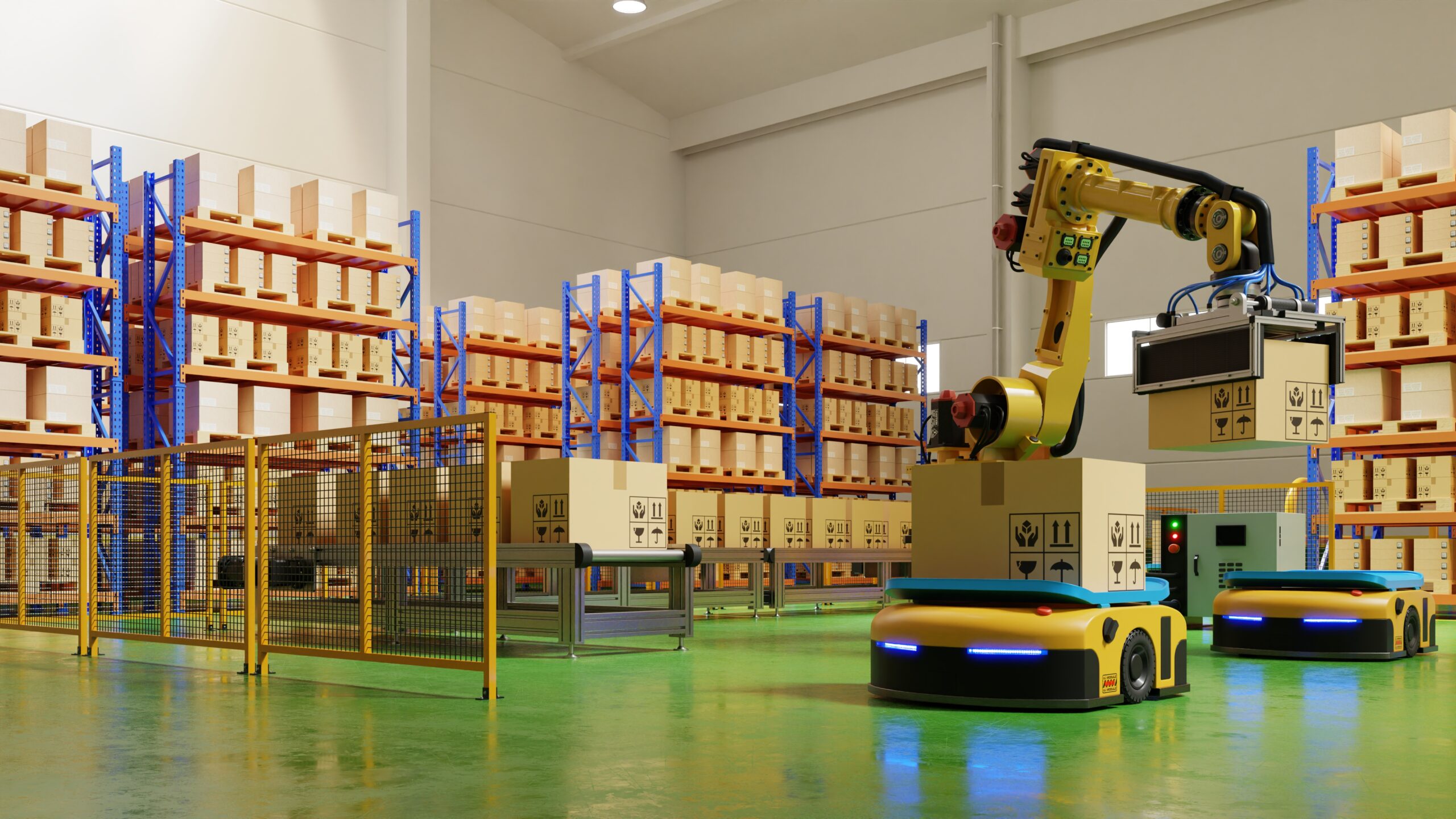
Modern warehouse robotics systems are capable of performing tasks such as automated product picking, goods-to-person transportation, autonomous pallet movement, automated sorting operations, and robotic assistance during packing workflows.
When robotics platforms are integrated with enterprise operational systems, businesses can significantly increase warehouse efficiency and throughput.
Robotic systems enable faster fulfillment processes because machines can transport products across warehouse environments far more quickly than manual labor alone. Automation also reduces dependency on human labor during peak demand periods, allowing organizations to maintain consistent operational performance even during rapid growth or seasonal surges.
Another important advantage is scalability. Robotic infrastructure allows warehouses to expand operational capacity without requiring proportional increases in staffing levels.
Consistency is also improved through automation. Robotic systems execute tasks according to programmed workflows, reducing the variability and operational errors that often occur in manual processes.
However, many robotics systems operate as independent platforms that are disconnected from the core enterprise systems responsible for order management, inventory data, and operational planning.
This disconnection is where 1CA ERP introduces a meaningful innovation.
Native RFID and Robotics Integration in 1CA ERP
1CA ERP integrates RFID and robotics directly into its operational ecosystem. Rather than functioning as separate external systems, these technologies become part of the central intelligence layer of the ERP platform.
This architecture enables real-time coordination between digital commerce processes and physical warehouse automation technologies.
RFID readers continuously transmit inventory data into the ERP environment, allowing product movements, inventory levels, and warehouse location information to update automatically in real time. Warehouse managers gain complete visibility across all storage facilities and distribution centers.
The system also enables automated workflow execution. When orders are placed through ecommerce platforms, B2B channels, or other sales systems connected to the ERP, the platform can immediately initiate automated fulfillment workflows. The system identifies product locations, assigns picking tasks to robotic systems, monitors fulfillment progress, and updates inventory levels as items move through the fulfillment pipeline.
In addition to workflow automation, the ERP platform serves as a centralized orchestration layer that coordinates robotics systems, inventory management, and operational workflows.
Through intelligent orchestration, the system ensures that robotic movements remain efficient, picking routes are optimized, and warehouse congestion is minimized. This coordination allows automation technologies to operate at peak efficiency while remaining aligned with broader business processes.
Because RFID and robotics operate directly inside the ERP environment, organizations also gain end-to-end operational visibility across the entire order lifecycle. Every inventory movement, warehouse transaction, and fulfillment event can be tracked and analyzed within a single system.
Benefits for Modern Commerce Businesses
The integration of RFID and robotics within 1CA ERP delivers measurable operational advantages for brands, retailers, distributors, and logistics providers.
Automation significantly accelerates order fulfillment processes, allowing businesses to reduce the time between order placement and shipment. This capability helps organizations meet rising customer expectations for fast delivery.
Inventory accuracy improves dramatically because RFID technology eliminates many of the errors associated with manual scanning and inventory entry.
Operational costs are also reduced over time. Automation technologies allow warehouses to increase throughput without requiring proportional increases in labor expenses.
The system also creates scalable infrastructure that supports long-term growth. As organizations expand their operations, automated systems allow warehouses to increase capacity without requiring major infrastructure changes.
Finally, businesses gain access to powerful operational data. Because RFID and robotics systems feed information directly into the ERP environment, organizations can leverage analytics and forecasting tools to optimize inventory strategies, warehouse workflows, and fulfillment performance.
The Strategic Advantage of Unified Commerce Infrastructure
A core philosophy behind 1CA ERP is the concept of unified operational infrastructure.
Many organizations operate with fragmented software environments composed of separate tools for ecommerce operations, warehouse management, inventory tracking, robotics control, and analytics.
This fragmentation introduces complexity and limits operational visibility.
1CA ERP takes a different approach by providing a unified platform designed to support every aspect of modern commerce operations. With the addition of RFID and robotics capabilities, the platform further strengthens its role as a comprehensive commerce operating system.
Within a single environment, organizations can manage ecommerce operations, B2B distribution workflows, warehouse automation systems, supply chain analytics, inventory intelligence, and order orchestration.
This unified architecture reduces operational complexity while improving efficiency across the entire organization.
The Future of Intelligent Warehousing
Warehouse automation will continue to evolve as emerging technologies such as artificial intelligence, robotics, and Internet of Things infrastructure become more deeply integrated into supply chain environments.
Businesses that adopt these technologies early will gain significant competitive advantages in operational efficiency, cost optimization, fulfillment speed, and customer experience.
By embedding RFID and robotics capabilities directly into its ERP ecosystem, 1CA ERP positions itself at the forefront of this transformation.
Organizations using the platform gain access to the tools necessary to build the next generation of intelligent commerce operations.
The introduction of built-in RFID and robotics capabilities represents an important milestone in the evolution of 1CA ERP.
By combining enterprise resource planning, warehouse management, automation technologies, and real-time operational intelligence within a single platform, 1CA ERP enables businesses to operate faster, more accurately, and more efficiently.
As supply chains grow more complex and fulfillment expectations continue to rise, unified platforms like 1CA ERP will play a critical role in shaping the future of global commerce.
Organizations that invest in intelligent operational infrastructure today will be best positioned to lead tomorrow’s commerce landscape.
 English
  Spanish